
Rehabilitation · 9 min read
Rehabilitation after amputation: what the road looks like, and why it's different for everyone
Artur Wąsowicz · July 20, 2026 · updated October 4, 2026
How long does rehabilitation after an amputation take? I asked that question of pretty much every doctor I dealt with at the time. Every one of them gave me a different answer, and only years later did I understand why.
A note before you read: this text describes my own road as well as the general shape of rehabilitation after amputation. My case was harder than average, because the amputation was not my only injury from the accident. In all likelihood yours will be shorter. The pace and the order of the stages depend on the amputation level, on age, on other conditions and on many other factors I write about further down, which is why this text cannot replace the plan you agree with your own doctor, physiotherapist and prosthetist.
When I came round, I wanted to hear a single number. How many weeks, how many months, when I would walk again. No one was able to pin it down precisely.
Today I know my number. For the first two and a half years I lived mostly in a wheelchair. I am putting it up front, with one condition attached. Do not map it onto yourself, since my road was long not because amputation takes that much time, but because in my case it was one of several injuries.
Rehabilitation after amputation has stages that almost everyone goes through, although there is no single timetable for everyone. So in every part of this text I write first about what is common to most people, and only then about how it went for me. If the two accounts differ, that is not a mistake. That is exactly what this article is about.
The rehabilitation that did not start with the residual limb
For most people after a lower limb amputation, everything from the first days points in one direction: wound healing, the shape of the residual limb and getting ready for a prosthesis. The plan is simple in principle, though hard in practice.
In my case that plan could not start. My accident was at the end of January 2020. After waking from a coma I learned that my left leg was gone, amputated above the knee. That, however, was only part of the list.
My right femur was broken in two places, fixed with an intramedullary nail and four screws. Both trochanters cracked. A cracked fifth lumbar vertebra. On top of that a broken scaphoid in my right hand.
I list all of this because rehabilitation after amputation rests on two pillars: the other leg, which takes over the body's weight, and the arms, which you push up on. For a long time I had neither.
So my clock did not start when the residual limb healed. It only started when the rest of my body allowed me to even try.
The first days, when only healing counts
In the first days, gait training is not on the table. Only healing counts, and the residual limb is swollen and noticeably sensitive to touch. A physiotherapist appears early on, though not to get anyone standing. They teach you to breathe more deeply and to move the hip joint through a safe range, so the muscles do not start losing strength straight away.
That is also when phantom limb pain shows up for most people. Estimates put it at roughly 60 to 70 per cent of people after amputation, and individual studies report figures as high as 80 per cent. The large majority feel it within the first week.
I was not prepared for it. When I felt toes that were no longer there, for a moment I thought something bad was happening, whereas it was not a sign of complications, only the way the brain deals with a sudden change in the body.
For me that pain did not stop at an episode. It was strong enough that for a long time I was taking nineteen painkillers a day. After the nights it broke up, I felt like a zombie. I write about it because phantom limb pain can drain all the energy rehabilitation needs, and then it turns from a symptom into an obstacle to getting your function back. Tell your doctor how bad it is. There are methods that ease it, and I describe them separately, in the texts on where phantom limb pain comes from and on neuroma and nerve procedures.
The residual limb sets the pace
Once the wound starts to heal, attention moves to the shape of the residual limb, and on that shape and on the limb's volume depend how well the future prosthesis will sit and how soon gait training can start. Progress here is barely visible from the outside, so frustration arrives faster than it did during wound healing. The same four things come back day after day.
- Bandaging or a silicone liner put on after surgery, meaning elastic compression that gives the residual limb a cylindrical shape and brings the swelling down.
- Strengthening, above all the glutes and the trunk, because those take most of the load once you walk on a prosthesis.
- Balance work, first at parallel bars, later with a walking frame.
- Desensitisation, getting the skin used to touch and pressure so the socket is not a shock to the nervous system.
I did all of it, except for longer and lying down or sitting, because I had no way to stand. I did not appreciate the first lesson of that period straight away. Working on the residual limb makes sense even when a prosthesis is a long way off. A residual limb nobody looks after for six months picks up a contracture and swelling, and then the whole job starts from a worse place.
Two and a half years off my feet
For me this stage lasted the longest.
Anyone whose prosthesis is delayed faces the same task. They have to keep the body in a state from which it will later be possible to start. There are two risks here, muscle wasting and contracture. Both are reversible only up to a point.
Hip flexion contracture is one of the more common problems after an above knee amputation. Sitting keeps the residual limb bent all day. If nobody straightens it deliberately, after a few months it stops straightening on its own. A prosthesis, on the other hand, needs extension, without which it cannot be aligned properly. I write more about this in the text on contractures.
For me there were three fronts: the spine, the residual limb and the right leg.
For the first six months I wore a brace. Without it I was allowed to lift my trunk to thirty degrees at most. I could sit upright or transfer to the wheelchair only once it was on. It sounds like a detail, yet it shaped the whole day, because every change of position became a separate operation.
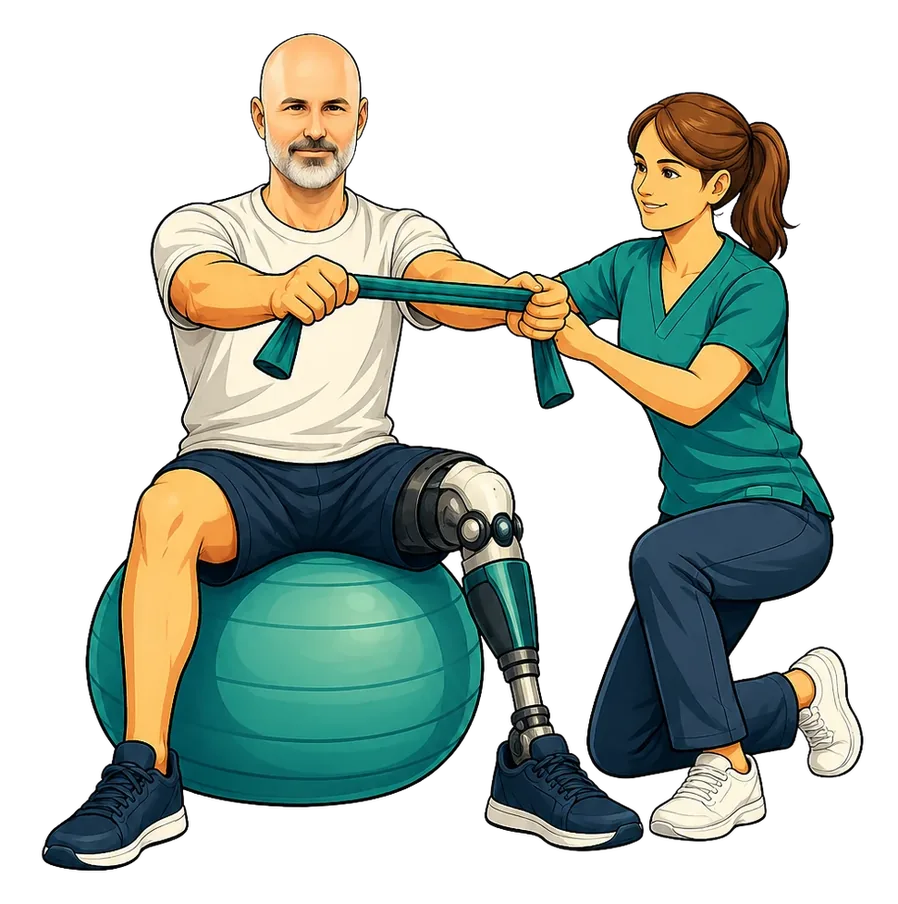
Everything I did then was kinesiotherapy, meaning work through movement, not treatments with currents or ultrasound. It came down to a few exercises repeated endlessly:
- resistance band exercises, for whatever I was allowed to load that week,
- lying prone, and in time sleeping prone, so the hip on the amputated side extended for hours rather than for ten minutes of exercise,
- stretching, mainly the hip flexors and the trunk,
- work on the right leg, so it would be ready to take the weight once the bone united.
I got upright as often as the state of the bone allowed, which meant not daily and not always regularly, but at every opportunity that came along.
In that period I had physiotherapy in hospital, as an outpatient, and once also as a residential course. It was almost continuous, though with gaps of several months that were not my choice. I mention them because if they happen to you as well, it does not mean everything is lost. What you do on your own, at home, with nobody watching, counts all the more then.
The best example is lying prone. It needs no equipment and nobody else in the room, and the difference it makes is enormous.
The first prosthesis
The first prosthesis is a preparatory one, meaning temporary, treated as a tool for learning and replaced later, once the residual limb stops changing shape so fast. Test sockets come before it, because the socket has to fit before mounting anything to it makes sense.
The first attempts at standing happen at parallel bars, with a physiotherapist or a prosthetist watching. You learn to shift your body weight from scratch, because a prosthesis does not respond the way your own leg did.
Walking on a prosthesis costs more energy than it looks like from the outside. Studies of people with above knee amputations show oxygen demand rising by anything from 20 to over 60 per cent compared with walking on two intact legs, depending on the study design and on the fitness of the person being tested.
For me that moment came after six months. It was decided not by the state of the residual limb but by the brace coming off. The same day it came off, I went to the prosthetist. First test sockets, first time standing, interim prosthesis.
My first distance was covered at the prosthetist's, inside the bars, a few metres. Then came the walking frame.
The tiredness after those few metres came straight away. At the time I took it as poor fitness, whereas it was ordinary physiology, the same that the oxygen demand studies quoted above describe.
I will not write that from that day on I was back on my feet, because I went back to the wheelchair and stayed there a long while yet. It was, however, the first day since the accident when I could see there was something to play for.
When the prosthesis is there and the bone says otherwise
A prosthesis does not close the subject, because the residual limb goes on living and changing. Most problems in this period concern the socket. It can be too loose or too tight, it chafes and leaves redness, and adjustments at the prosthetist's sort that out. It is like a shoe that was comfortable not long ago and now rubs, even though it is the foot that has changed, not the shoe.
Not every problem comes from the socket, though. There are symptoms where the next adjustment will change nothing, because the cause lies under the skin.
In my case haematomas started forming at the end of the residual limb. After putting the socket on, I also had a very specific pain. An X-ray showed osteolysis at the end of the femur, bone tissue disappearing at the tip.
It ended in a re-amputation with revision of the residual limb. It was one of several operations I went through in that period, alongside, among others, dynamisation of the femur and a change of the intramedullary nail.
A re-amputation turns the clock back. Healing returns, swelling returns, shaping the limb returns, and on top of that a new socket is needed. Everything I described above about shaping the residual limb, you do a second time.
If pain only appears after you put the socket on and keeps coming back despite adjustment after adjustment, or if something on the residual limb keeps repeating, haematomas for instance, that is the moment for imaging, not for another fitting appointment. Say it to your doctor in plain words.
Getting back to an ordinary day
Gait training in a rehabilitation gym is one thing and an ordinary day is something else entirely, because a flat floor and parallel bars have little in common with an uneven pavement, the rush at a bus stop or a shop full of people. So at this stage new tasks come in:
- stairs up and down, one of the earliest tasks, but a long time before it feels certain,
- uneven ground and slopes, because a prosthesis responds differently to every change of surface,
- going back to work and to daily responsibilities, gradually, not in one day,
- if sport is the goal, the conversation about returning to physical activity, ideally only once basic walking is stable.
This is also the point to judge whether the interim prosthesis is still doing its job or whether it may be time for a definitive one. That decision is not made once and for all, because the residual limb changes shape and volume for up to two years after amputation, with the biggest changes in the first months.
Correcting my gait pattern took longer than learning to stand. The natural tendency is to compensate for the missing leg with the whole body, which over time loads the spine and the remaining limb. In my case the risk was doubled, because the spine was already damaged and the other leg had been through fractures. My physiotherapist corrected me on literally every step.
Why it looks different for everyone
From conversations with other people after amputation I come away with wildly different stories: some were walking independently after a few weeks, others only after a few years. The difference comes from factors that line up differently for everyone.
- Amputation level. A below knee amputation usually demands less energy and a shorter period of gait training than an above knee one, because a preserved knee joint makes controlling the movement far easier.
- Other injuries and the state of the remaining limb. For me this was the deciding factor. Since rehabilitation rests on the other leg and on the arms, damage to them pushes every stage back in time, no matter how well the residual limb itself is healing.
- Age and general fitness before surgery. A body that was active beforehand regains muscle strength and the endurance gait training needs more quickly.
- Coexisting conditions, diabetes and vascular disease in particular, which slow wound healing, so some stages last longer than they do for other people.
- The reason for the amputation. Rehabilitation after trauma often runs differently from rehabilitation after a long illness that eventually led to amputation.
- Complications. A re-amputation, an infection or a bone problem push the whole process back to an earlier stage. I know this from my own experience, described above.
- Access to a physiotherapist and a prosthetist. From what I saw in my own case and heard from other people, regular and frequent appointments move things along more than rare sessions, however intense.
- Mental state. Frustration and grief after losing a limb are a natural part of this process, not a sign of weakness, and they also genuinely affect how fast function comes back. Talking to a psychologist can be as necessary at this stage as physiotherapy.
All of this concerns leg amputation. Rehabilitation after the loss of a hand or a forearm follows different rules, because there what matters most is manual function, not walking, and I write about the road I know from my own experience.
What stays once intensive rehabilitation ends
The end of the most intensive stage does not mean the end of the work. My residual limb kept changing for nearly two years, so the socket had to be refitted several times over. Regular check ups with the prosthetist and the physiotherapist are with me for good, even when everything is working well.
What also stayed is work without end: the spine and the remaining leg. For me that is not prevention but necessity, because both have already been through a lot. It does, however, apply to every person walking on a prosthesis, including those without extra injuries. The remaining limb works for two for the rest of your life.
What I would tell myself before the operation
I would tell him not to measure his pace against other people's, because each of those stories unfolds under different conditions. Mine does not match yours either. I am writing that deliberately at the end of a text in which I have told it from start to finish.
I would tell him that days without progress do not mean going backwards, because the body is then working on something you cannot see yet. Across those two and a half years I had more of those days than any other kind.
And I would tell him to ask directly every time something is unclear, because the best support in this process is a team one trusts, not an article on the internet, this one included.
Pass it on
Know someone who could use this text? Send it to them.
What comes next
Next step Foundation and organisation support Where to look for funding for a prosthesis, rehabilitation or equipment beyond NFZ and PFRON.- ArticleContractures after amputation. Why the residual limb settles into flexion and how to prevent it
- ArticlePhantom limb pain. Something that is not there hurts. Where it comes from and what helps
- ArticleNeuroma, radiofrequency ablation, cryoablation and nerve surgery. What to do when the pain comes back years later
Have a question about your own stage of rehabilitation? Write to us through the contact form. We will not replace your medical team, but we are glad to point you towards where to look next.

Sources
- Pogorzała A.M., Rohde A., "Causes, types and levels of lower limb amputation", University of Education and Therapy in Poznan (in Polish) – wydawnictwo.wseit.edu.pl
- Genin J.J., Bastien G.J., Franck B., Detrembleur C., Willems P.A., "Effect of speed on the energy cost of walking in unilateral traumatic lower limb amputees", European Journal of Applied Physiology (2008) – link.springer.com
- Limakatso K., Bedwell G.J., Madden V.J., Parker R., "The prevalence and risk factors for phantom limb pain in people with amputations: A systematic review and meta-analysis", PLoS One (2020) – journals.plos.org
- Bornemann-Cimenti et al., "Early Onset and Treatment of Phantom Limb Pain Following Surgical Amputation", Pain Medicine (2017) – academic.oup.com
- Kaufman et al., "Energy Expenditure and Activity of Transfemoral Amputees Using Mechanical and Microprocessor-Controlled Prosthetic Knees", Archives of Physical Medicine and Rehabilitation – sciencedirect.com