

Life after amputation · 9 min read
Changing residual limb volume. Why a prosthesis holds better in the morning than in the evening
Artur Wąsowicz · September 14, 2026
By the evening the limb gets smaller and the socket a little looser. These days that difference is barely noticeable for me. Through the first years after the amputation it was considerable, and always in the same direction.
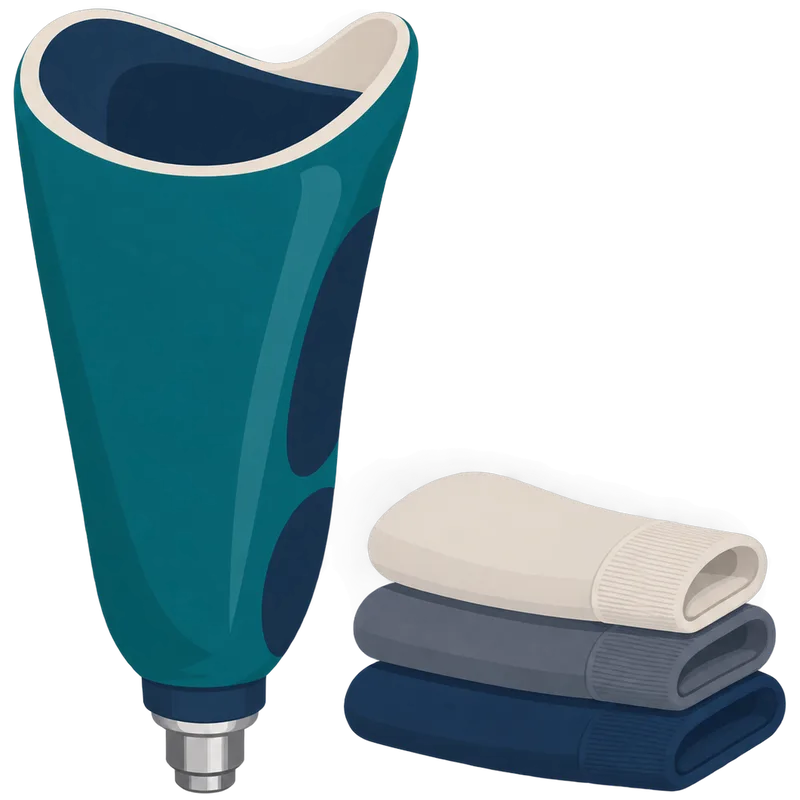
The advice you hear most often among people with amputations in Poland is this: add a sock when the prosthesis starts to feel loose. True, but only half the story. Residual limb volume changes for two independent reasons at once, on the rhythm of a single day and on the rhythm of the first months after amputation. Each of them calls for a different response. There are also more ways of dealing with it than that one piece of advice suggests. Socks are the cheapest and the most widespread. Alongside them sit solutions that change the volume of the socket itself: a lace mechanism with a dial, air bladders in the soft insert, inflatable overlays. A few more are only now reaching the market.
A limb that will not stand still
Right after surgery the residual limb has a volume it will never have again. Muscles that did no work through the hospital stay lose mass. The lymphatic and venous vessels are only learning to drain fluid from an area the rest of the limb used to drain. The first weeks are usually swelling. Then, once you start loading the limb, muscle rebuilds and the circumference grows the other way. The two processes overlap, which is why a socket that fitted perfectly a month after fitting can be a size too big six months later.
Research gives a fairly consistent timetable here. The largest changes in the shape and size of the limb fall in the first four to six months, and smaller ones can run on for twelve to eighteen months after surgery. For me it took longer, closer to two years. Only then did the fluctuations become small enough to stop mattering in practice.
The second rhythm is measured in hours. Exertion, ambient temperature and hydration change limb circumference within a single day, usually in the same direction — the limb is largest in the morning and smallest in the evening, after hours of activity. The scale varies between people. In studies where these changes were measured with instruments, fluctuations during ordinary daily activity reached several per cent of volume per hour, in both directions.
What happens when the socket stops fitting
A socket that is too loose starts as a sense that the limb is swimming inside it. Then the prosthesis rotates as you transfer weight, and sometimes you hear air being drawn in with every step. In time a compensatory gait follows: limping, shortening the step, hitching the hip to swing the prosthesis through at all. The body handles this on its own, but at the cost of the hip joint, the sound knee and the lumbar spine, which take on work they were not built for.
Where the socket is too tight, the situation can be worse. Pressure, numbness, a throbbing sensation or difficulty getting the prosthesis on are all easy to ignore. Especially when the socket used to fit well and it seems like something temporary. Ignored pressure over many hours a day leads to abrasions and broken skin.
The scale of this is larger than it looks. A review of clinical data puts skin problems on the residual limb at between twenty four and forty one per cent of people using a lower limb prosthesis, with poor socket fit and poor sock management behind the large majority of those cases.
Redness and abrasion are a matter for the prosthetist and the nurse. A wound that will not heal, weeps or looks infected needs a doctor, not a socket adjustment.
The first route: prosthetic socks
Prosthetic socks are the oldest and still the most widely used answer to changing volume. They go on the limb, under the socket, in as many plies as it takes to fill the socket once circumference has dropped. In the morning you wear the fewest. By evening you add another, sometimes two. Thickness is counted in plies, most often one, three and five, and these can be combined.
The system is cheap. The Polish health fund reimburses up to six textile items a year under code Z.03.01, so the running cost is low.
The limits show up clearly in the data. In a fourteen-day observation of twenty three people with below-knee amputations, socks were changed on average less than once a day, while total thickness rose across the day from just under five plies to five and a half. The reason is mundane — to add a ply you have to take the prosthesis off, and in the middle of the day, away from home, there is rarely the place or the appetite for it.
There is one more cost that rarely gets written about. Every added ply is another sock on the limb. In summer, or under heavier exertion, a limb under three or four plies sweats considerably more, and moisture on the skin is a short road to abrasion.
On top of that, socks compensate for circumference in steps, ply by ply, rather than smoothly. Between one thickness and the next there is always a margin of mismatch. For one group of people that margin is something you can live with, for others, particularly with large daily fluctuations, it is not acceptable.
The second route: adjusting the volume of the socket itself
The second approach changes the volume of the socket rather than adding material to the limb. There are several solutions, and they differ both in mechanism and in price.
A lace mechanism with a dial. The most widespread is RevoFit by Click Medical, built around the BOA dial, the same one familiar to anyone who has had snowboard or cycling boots. The prosthetist laminates guide tubes into the socket wall, a lace runs through them, and the user tightens or loosens the whole thing with the dial, through clothing if need be. The manufacturer distinguishes three adjustment designs: a movable panel in the wall, a gap drawn together by the lace, and a hinge. One click corresponds to roughly a millimetre of compression, and the full range replaces about ten plies of socks. Over the past decade the system has gone into more than a hundred thousand sockets worldwide.
I wore a socket with exactly this arrangement for several years: a soft insert against the skin and a lace running through a panel in the wall, tensioned by a dial. Circumference changed smoothly, without taking the prosthesis off and without socks. I rate the adjustment as very good. It let me respond as I went, without waiting for discomfort to become obvious. In the morning I tightened more, after a few hours of walking I let it out.
Air bladders in the soft insert. You also find sockets whose insert has chambers filled with air. Volume is adjusted by pumping air in and letting it out, and the principle is the same as with the lace: we change the socket, not the limb.
An overlay worn over the liner. The Overlay by Ethnocare has recently reached the market: a thin sleeve of breathable fabric with a built-in system of air chambers. It goes over the liner, under the socket, with no modification to the prosthesis. A pump, usable through clothing, adjusts thickness corresponding to roughly two to fifteen plies of socks. The manufacturer offers versions for below-knee and above-knee levels. I had a chance to test it and I consider the solution very useful, although the unit I was given turned out to be too large for my limb and I could not wear it.
An adjustable socket is not a novelty. It has had its place in prosthetics glossaries for years, described as a design in which the patient adjusts the fit themselves. The solution is well known in the trade, only its price means it is chosen less often than a standard socket.
What is not here yet, and may be before long
Everything described above shares one feature: a person does the adjusting. You have to notice something is off and reach for the dial or the pump. For several years now a number of teams have been working to remove that step. None of these solutions is available in a Polish workshop yet, so I describe them as what is coming rather than as an option to choose.
The British company Unhindr, a spin-out from Imperial College London, is developing a liner called Roliner. It is a silicone elastomer insert with a network of microscopic fluid-filled channels that change its shape, volume and stiffness, controlled from a phone. Its thickness is designed to fit existing sockets without modifying the prosthesis. Since 2018 the team has collected more than a dozen awards and over a million pounds in funding, including half a million from the British agency Innovate UK to examine the feasibility of series production. Entry to the British market was announced for the end of 2025.
The American team at Quorum Prosthetics is taking a different route, under the name AVA Fit. A pressure sensor matrix and a motion sensor sit in the socket wall, and the computation runs in the socket itself, without sending anything to a network. A pressure map overlaid on a scan of your own socket appears on the phone, together with a fit score. The manufacturer states plainly that the sensing part is ready while the adjusting part, a lace mechanism driven by the sensors, is still being built. There is also a planned function for recording what happened inside the socket between one visit to the prosthetist and the next, which for the prosthetist is often worth more than a patient's account from memory.
Other ways sockets differ
Fabrication technology is a separate matter from adjustment. A socket can be laminated over a plaster model, 3D printed, or made directly on the patient's limb. Össur offers that last route in Poland under the name Direct Socket, in versions for above-knee and below-knee levels. The socket is formed from composite directly on the limb, in a functional alignment, with no casting stage, and in favourable conditions the patient leaves with a finished prosthesis the same day. I have one such socket, having been invited as a model to a training course run by the manufacturer.
At the moment I am walking in a test socket made by 3D printing. I have had such sockets before, including definitive ones, except that none of them was adjustable.
What it costs and where to find the money
To take one example, funding for the above-knee level sets out a separate limit for an interim prosthesis, from 5,000 to 8,000 PLN depending on mobility level, and a separate one for a definitive prosthesis, from 5,500 to 20,000 PLN. Two further items cover socket replacement alone: 2,000 PLN with an interim prosthesis and 3,500 PLN with a definitive one.
These limits do not add up within a single provision. The limit for a definitive prosthesis already covers the socket inside it. The socket replacement item comes into play later, once you have a prosthesis and need to replace the socket alone, without the rest. So you cannot walk into a workshop with an arithmetic in which twenty thousand for a prosthesis adds to three and a half thousand for a socket.
The interim socket is a separate matter for another reason. It is neither a bonus nor a trial version to be discarded, but a stage you usually have to pass through before the prosthetist starts building the definitive socket. In the early period the limb changes too fast to make the final version straight away.
The health fund limit is not the end of the possibilities, and this is probably the most frequently omitted piece of information in the whole subject. When the price exceeds the limit, you can apply at the district family support centre or the municipal social welfare centre for funding from the state disability fund. The top-up reaches one hundred and fifty per cent of the sum of the health fund limit and the required own contribution. With a limit of 3,500 PLN for replacing a socket in a definitive prosthesis, that comes to a further 5,250 PLN. An income test applies, calculated for the quarter preceding the month of application: fifty per cent of the average wage per person in the household, or sixty five per cent for a person living alone. Applications are accepted year round, and the final amount is set by the local authority, so practice varies by district and by how much is left in the pot.
A separate route is the Active Local Government programme. Care is needed here, because a good deal of confusion circulates about it. Task three in area C covers the purchase of a whole prosthesis at least at the third quality level, not the socket alone. For people who already have a prosthesis, the right one is task four, help in maintaining the technical condition of a prosthesis you already own, with a ceiling of thirty per cent of the amounts set for task three. Those funds pay for keeping a prosthesis running, which includes replacing a socket or adapters.
When even that is not enough, what remains is paying the difference yourself, a fundraiser, or giving up the more expensive solution for whatever fits within the limit.
When adjustment is no longer enough
A dial and a lace have a range beyond which nothing more can be tightened. There are several signs that this is no longer a matter of adjustment but of replacing the socket. A crack or delamination in the socket itself. A mechanism that stops holding its setting despite being tightened to the stop. A limb that still moves inside the socket at the full range of adjustment.
Change in the shape of the limb stands apart. Adjustment changes tightness, not geometry, so once the limb has changed in more than circumference, no dial will make up for it. The regulations in fact provide for shortening the service life in exactly that situation, on an application with medical justification. I write about this in the article on reimbursement from the health fund.
What comes next
Residual limb volume returns in the article on swelling and compression and in the one on contractures, because all three happen in the same period and bear on one another. The route through the district family support centre and through the Active Local Government programme is set out step by step in the article on funding from the state disability fund.
Sources
- „Projektowanie protez", teaching material for qualification MED.11, authored
by a team from Lodz University of Technology and Poznan University of Medical Sciences, section on designing a prosthetic socket at the above-knee level – zpe.gov.pl
- Sanders J.E., Fatone S., „Residual limb volume change: systematic review of
measurement and management", systematic review, Journal of Rehabilitation Research and Development, 2011, vol. 48, no. 8, pp. 949–986 – doi.org
- Sanders J.E. and colleagues, study of prosthetic sock use among people with
below-knee amputation, a fourteen-day observation of twenty three participants, with data on how often plies were changed – pmc.ncbi.nlm.nih.gov
- Amputee Coalition, limb loss definitions, entry on the variable-volume
socket – amputee-coalition.org
- Click Medical, description of the RevoFit system with the BOA dial –
- State Fund for the Rehabilitation of Disabled Persons, announcement on the
Active Local Government programme in 2026, scope of area C – pfron.org.pl
- Össur, description of the Direct Socket technology for the above-knee level –
- Unhindr, description of the Roliner adaptive liner –
- Quorum Prosthetics, description of the AVA Fit system –