

Life after amputation · 7 min read
Contractures after amputation. Why the residual limb settles into flexion and how to prevent it
Artur Wąsowicz · September 8, 2026
Almost everyone is told how to position the limb, usually once, at discharge. The harder part is keeping it up through the months of waiting for a socket, and then through the hours of the day when the prosthesis stands in the corner.
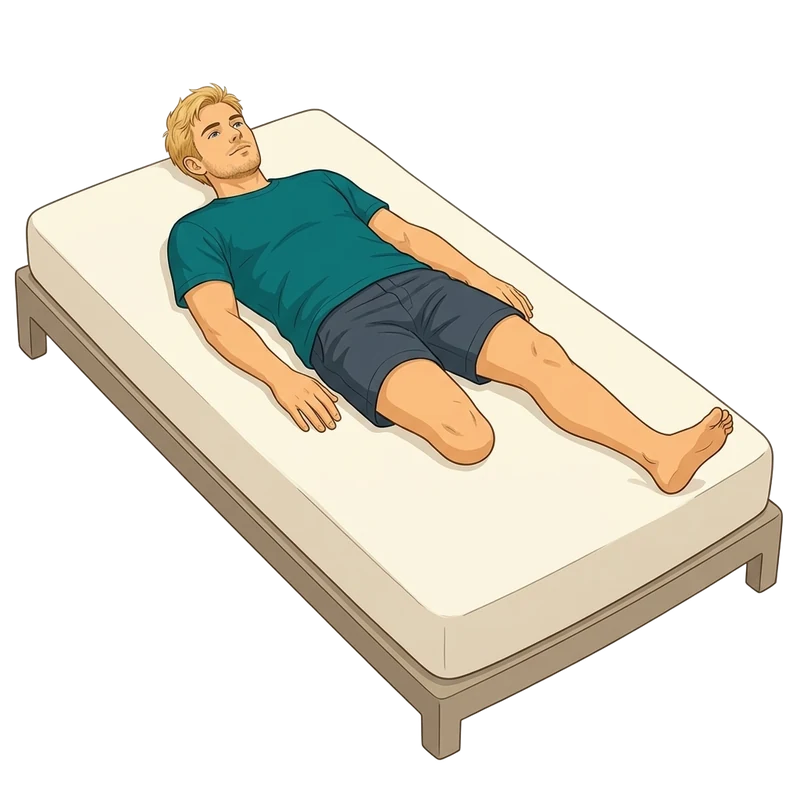
The position that feels best after surgery and the position that serves the limb are usually two different positions. You normally do get instructions, except that you get them once, on the day you go home, when you retain maybe a third of the whole conversation. After that the watching is on you, and it lasts as long as you wait for a socket. In my case that was six months, and that is not a particularly rare case.
A contracture is a lasting restriction of movement in a joint. Tissues around a joint that has stood in one position for several days shorten and stop giving. The joint still bends, but it no longer straightens all the way. After an amputation this is not a matter of how your walking looks. A prosthesis is built around the assumption that the limb lines up. If the hip does not come down below a certain angle, the prosthetist has nothing from which to build a socket that will carry the load downwards.
This text is educational and does not replace medical advice. Which positioning and which exercises are right in your case is decided by the doctor treating you and by a physiotherapist, who know the state of your wound and how the surgery went.
Why the limb drifts into flexion
Three things add up at once.
The first is pain. A flexed joint has a looser capsule and lower pressure inside, so it hurts less. The body looks for that position on its own, before you have a chance to think about it. It is called an antalgic position and it is a reflex, not a decision.
The second is the muscles. Once part of the limb is taken off, what remains is an uneven contest of forces. At thigh level the flexors and the muscles that abduct the hip have their attachments above the cut and go on working. Their opponents, the extensors and the adductors, lose part of their attachments. So the limb travels forward and outward.
The third is the day itself. Eight hours of sleep in a curled-up position plus six hours sitting in a wheelchair makes fourteen hours of a flexed hip. The rest of the day does not make that up. A contracture does not come from one bad movement, it comes from arithmetic.
Above-knee amputation. Hip in flexion and abduction
Here the contracture goes in two directions at the same time. The limb lifts forward and drifts to the side. A few days of lying with a roll under the limb is enough to see the difference.
In practice what follows is that standing in a prosthesis, the pelvis has to make that difference up somehow. It usually compensates with an anterior tilt and a deepened lumbar curve. The lower back starts to hurt not because of the prosthesis, but because of what the body does to stand upright in spite of the contracture.
Below-knee amputation. Knee in flexion
Below the knee the stake is the knee itself, and it is a high stake. The knee is meant to stay your own, working, and straightening to zero. The whole advantage a below-knee prosthesis has over an above-knee one comes precisely from a preserved knee.
Three situations work against that knee every day. A pillow slipped under a bent knee, because it is more comfortable that way. The limb hanging for hours over the edge of the bed. And a wheelchair with no support, on which the limb hangs in the air, bent, for a whole afternoon.
The day, not the exercise
A contracture is prevented by how you are positioned across the day, not by a dozen repetitions once a day. Exercises have their place, but they will not work off fourteen hours spent in a bad position.
Daily stretching is a standard physiotherapy recommendation and there is no reason to drop it. It is worth knowing what it answers, though. A broad review of research on stretching in people with contractures and at risk of them showed that a stretching episode on its own changes range of movement by single degrees, which is to say by an amount you do not see in practice. The studies covered short sessions rather than long holds of a joint in extension, and that is an important difference here. Stretching keeps the tissues gliding around the scar and keeps the limb tolerant of movement, and that is what it is worth doing for. Desensitising the limb to touch is separate work, based on tactile input, and stretching does not replace it. Range of movement, on the other hand, is won with hours spent in extension.
Positioning across the day
- Lying on your back, the limb lies flat on the mattress, straight, with no roll underneath and no pillow between the thighs.
- After an above-knee amputation the limb stays against the other leg and does not drift to the side. You can prop it from the outside with a rolled blanket so that it does not wander.
- After a below-knee amputation the knee stays straight. Support goes under the whole lower leg, never under the back of the knee.
- Sitting in one stretch is limited. Change position every hour, even if only for a few minutes.
- A wheelchair with a support under the limb, set so that the limb rests rather than hangs.
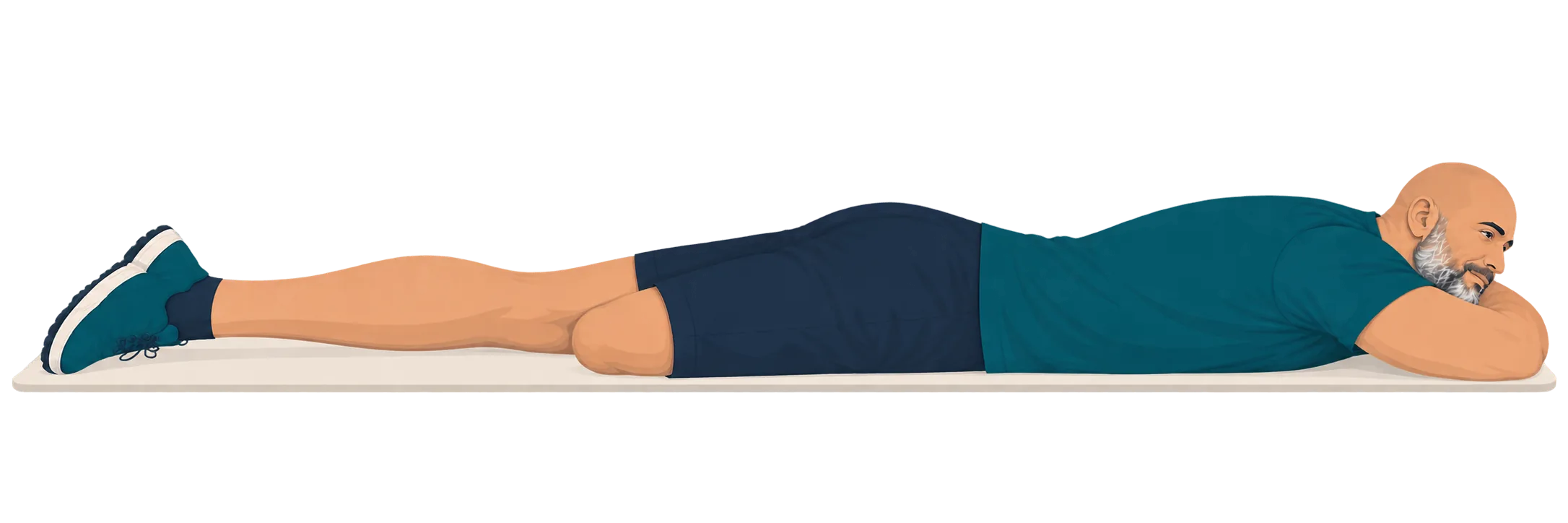
- Lying on your front, if the doctor treating you and the state of the wound allow it. Usually several times a day, for a quarter of an hour or so, with the hips flat against the surface.
Lying on your front is the position that gets left out most often, and the one that does the most good after an above-knee amputation. Body weight straightens the hip on its own, with no effort from you. There is one condition and it must not be worked around: agreement from the team treating you, because the state of the wound, the dressing, and whether you can turn onto your front at all is decided by a doctor, not by a text on the internet.
How you notice something is happening
A contracture usually does not hurt until you start to straighten it, which is why it is so easy to miss. There is no moment where something snaps and you know you have to react. Range disappears a few degrees at a time, until one day the limb no longer lies flat.
The limb does not touch the mattress
You lie on your back, the limb stays lifted and will not drop. There is a visible gap between it and the bed.
The limb drifts to the side
At rest it does not stay against the other leg, it moves outwards on its own.
The knee does not straighten fully
Below the knee, a few degrees are left that you cannot close without a hand.
Straightening starts to pull
Not sharp pain, a feeling of tension and resistance in the groin or behind the knee.
A change from week to week
The same position works out worse than it did seven days earlier.
The lower back speaks up on standing
Coming upright, the back takes over what the hip is not doing.
A simple way to check this yourself: once a week lie flat on your back on a firm surface, bend the other leg and pull it towards your chest, and see whether the limb stays down. If it lifts, range has started to slip. This is not a diagnostic test and it does not replace an examination. It is a signal to make a phone call.
When to call
Call a physiotherapist straight away rather than in a month. The reason to get in touch is when the limb stops lying flat, when straightening starts to pull, and when you see a difference against the previous week. A fresh contracture, a few days old, goes back with a change of position. One that is a few weeks old already needs therapeutic work. A socket can usually still be built, only worse aligned, and the bill for that is paid in your walking and your spine.
If you have no physiotherapist assigned, ask for a referral at the first follow-up appointment. You have to ask yourself, because a referral has a way of not appearing unless you bring it up.
The prosthesis does not close the subject
It is easy to assume that once the socket is ready and you are walking, the hip looks after itself all day. That holds only when the prosthesis is actually on the leg all day, and that does not happen every day. There are days of eight or twelve hours and there are days of two or four, after which you come back to the same arithmetic as before the prosthesis. On top of that come the evening hours at home, when the prosthesis stands in the corner and you sit.
The check, on the other hand, is simpler than before and needs no test. You take the prosthesis off and look at whether the limb stays straight or goes into flexion by itself. The second signal is more convenient still, because it comes on its own: if you do not have to keep correcting the fit of the prosthesis during the day, it means the limb is going into the socket the way it used to. When you start adjusting more often than usual, it is worth checking extension before you decide it is the socket alone. Extension does not exhaust the matter, though. If the correcting comes back at the same time of day, the cause is often not the angle but the changing volume of the limb, and that is a subject for prosthetic socks.
So the positioning rule has no end date. When the prosthesis is off, the limb goes back to the same rules: flat when lying down, knee straight, no pillow underneath, sitting broken up. Range you have won is lost just as quietly as the first time, with the difference that now you see the result at once, because the socket stops seating the way it used to.
Positioning and compression
Positioning and compression are two sides of the same matter. A bandage or a shrinker shapes the volume, positioning watches the angle. One without the other works half as well. How to use a bandage, and how a shrinker differs from a prosthetic sock, I wrote about in a separate text on swelling and compression.
Pass it on
Know someone who could use this text? Send it to them.
What comes next
Next step Choosing a prosthetic practice What the first visit looks like, how to build a working relationship with your prosthetist and what to look for when choosing a provider.- ArticleRehabilitation after amputation: what the road looks like, and why it's different for everyone
- ArticleResidual limb care in the first weeks. What I learned in practice
- ArticleChanging residual limb volume. Why a prosthesis holds better in the morning than in the evening
Got a question? Write to us through the contact form. We answer every message.

Sources
- „Wczesne usprawnianie poamputacyjne i nowoczesne techniki hartowania kikuta”, e-textbook, authors from Lodz University of Technology and Poznan University of Medical Sciences, the part on the first day after surgery and on contraindicated positions – zpe.gov.pl
- The same e-textbook, introductory part, where a contracture is described as a complication arising from holding the limb too long in one position – zpe.gov.pl
- The same e-textbook, the part on the period before amputation, on strengthening the extensors in amputation at thigh level – zpe.gov.pl
- Harvey L. A. et al., „Stretch for the treatment and prevention of contractures", Cochrane systematic review, 2017, forty-nine studies and over two thousand participants - cochranelibrary.com
- VA/DoD Clinical Practice Guideline for the Rehabilitation of Individuals with Lower Limb Amputation, updated edition of 2024, published in January 2025 – healthquality.va.gov