

Portal section
Bionics – what does it actually mean?
This section is the basics. It is the place to start before you move on to the more detailed topics elsewhere on the site. We write it from the point of view of someone with limb loss, because the foundation’s founder has been through it himself.Artur Wąsowicz, foundation founder, prosthesis user since 2020
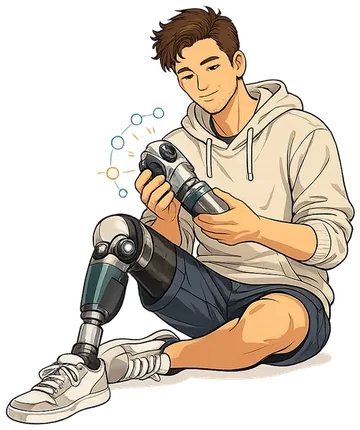
Bionics – a definition
Bionics is an interdisciplinary field of science and engineering that studies the biological processes, structures and mechanisms found in living organisms, and then uses that knowledge to build technological solutions, devices, materials and systems.
Educational content: descriptions of technologies and prosthesis types are for information only. Always discuss the choice of specific prosthetic equipment with an orthopaedic doctor and your prosthetist.
Articles from this section
Every text in this section, newest first.
Coming up
-
The history of prostheses
From wood and metal to carbon fibre and electronics. How prostheses changed alongside medicine and technology.
-
Walking with a prosthesis
The phases of a step, prosthesis alignment and compensations. Why walking with a prosthesis takes more energy and what affects it.
-
How a prosthesis is made
From measuring the residual limb, through the test socket and alignment, to the final fitting and first adjustments. What happens at the practice at each stage and how long it usually takes.
-
Prosthetic hands and fingers in practice
What individual models can do and how their control works in everyday tasks. Knowledge that makes it easier to talk to your prosthetist.
-
Knees in practice
Mechanical and microprocessor. How specific models behave on stairs, on slopes and at the end of a long day. Knowledge that makes it easier to talk to your prosthetist.
-
Feet in practice
Stiffness, energy return and walking on uneven ground. How specific models perform in everyday conditions. Knowledge that makes it easier to talk to your prosthetist.
We keep the list of prosthetics manufacturers in the Resources section, and we cover research into new technologies in Innovations.
Come across a term you don't know?
Look it up in the glossary in Resources. It’s one place with every definition from across the site.
Open the glossaryPrefer watching to reading?
In “Proteza w Realu” (Prosthesis in Real Life) the foundation’s founder tries out prostheses and components in everyday life, from a user’s point of view, not a manufacturer’s.
See the planned seriesWant to talk to someone who's been through it?
The Community section brings together people with limb loss, the people close to them and specialists.
Go to Community