

Prosthesis types · 17 min read
Lower limb prostheses. Types, structure and selection
Artur Wąsowicz · October 4, 2026
A prosthetic leg is not one object. It is a set of parts matched to the residual limb and to the person who walks on it. This text sorts lower limb prostheses by amputation level and describes what they are made of.
Disclaimer: this text sorts lower limb prostheses into types. It is not a fitting. Which prosthesis suits you in particular is something you settle together with your prosthetist at a prosthetic clinic.
Sooner or later everyone who has lost a leg hears the question "so what kind of prosthesis have you got?". The answer rarely fits in one word, because a lower limb prosthesis is not a single object. It is a set of parts matched to a particular residual limb and to a particular person who walks on it. It may replace only the front of the foot. It may also replace the whole leg, knee and hip joint included.
That is why the same prosthesis can be described in several ways at once. We talk about the amputation level, about the construction, the socket and the suspension, the prosthetic foot, and in an above-knee prosthesis the knee as well. Each of these descriptions is true. None of them is complete on its own.
Where the division starts
The amputation level tells you the most. It decides the rest. It determines which joints and muscles are left and so which functions the prosthesis has to take over. Two people amputated at the same height can still walk on completely different prostheses, with a different socket, different suspension and a different foot. So the classification of lower limb prostheses is not a closed list. It is a handful of criteria that overlap.
| Divided by | What it covers | For example |
|---|---|---|
| Amputation level | the height at which part of the limb was lost | foot, ankle joint, lower leg, knee joint, thigh, hip joint |
| Construction | how the load bearing part of the prosthesis is built | exoskeletal, modular |
| Prosthetic socket | the link between the residual limb and the rest of the prosthesis | shape depends on the amputation level and the condition of the residual limb |
| Suspension | keeping the prosthesis on the residual limb | vacuum, pin, sleeve, anatomical |
| Prosthetic foot | contact with the ground and work during a step | rigid, single axis, multiaxial, dynamic |
| Prosthetic knee | guiding and controlling flexion | single axis, polycentric, pneumatic, hydraulic, microprocessor |
| Stage of fitting | the point reached in rehabilitation | interim, definitive |
The mobility level is left out of the table on purpose. Polish regulations distinguish four levels, from a person who moves around the flat on crutches or with a walker to a very active person whose prosthesis has to withstand heavy loads. But the mobility level describes the person. Not the equipment.
Lower limb prostheses
Amputation level
Prosthetic foot
Types of prosthesis by amputation level
Partial foot prosthesis
An amputation within the foot may take only the toes, the front of the foot, or so much of it that just the heel is left. On a discharge summary these levels often carry the names of surgeons, Lisfranc or Chopart for example. The less of the foot remains, the harder it is to roll body weight from heel to toes and the more work the device has to do.
Not every one of these cases needs a prosthesis shaped like a whole foot. The Polish Minister of Health regulation on medical devices issued on prescription lists a prosthetic shoe insert that fills out the foot, a version of it that assists push off, and a partial foot prosthesis. After a small amputation a well fitted insert in an ordinary shoe can be enough.
Ankle disarticulation prosthesis
After this amputation the whole lower leg remains, but the foot is gone together with the ankle joint. In your records you may see the name Syme or Pirogoff. A residual limb like this can usually take body weight on its very end (it is then called end bearing), which is a big advantage. It also has a drawback that is less obvious. A long residual limb leaves little room underneath for a prosthetic foot, so low build height feet are used, and around the ankle the prosthesis tends to be wider than the other leg.
In the regulation I mention above, definitive ankle level prostheses are divided according to the user's mobility level.
Transtibial (below-knee) prosthesis
The below-knee prosthesis is the most common lower limb prosthesis. The user keeps their own knee joint, so the prosthesis does not have to replace it and the whole structure sits below the knee: socket, suspension, the shank (the section between the socket and the foot) and the foot.
Your own knee makes an enormous difference here. Bending and straightening are controlled by muscle, not by a mechanism, which is why walking after a below-knee amputation is usually less tiring than after an above-knee one.
Polish regulations provide for a temporary below-knee prosthesis and for definitive ones, exoskeletal and modular. They also cover a version with a thigh corset and a joint at knee level, used when the residual limb is very short or the knee needs extra stabilisation.
Knee disarticulation prosthesis
In a disarticulation at the knee the femur stays whole, while the lower leg is removed along with the joint. The residual limb is long and usually bears load at its end, and the wider end of the femur helps hold the prosthesis on. What is missing is the knee. So the prosthesis needs an artificial one.
And this is where a geometry problem appears. The knee mechanism has to sit below the end of the residual limb, so when you sit down the thigh with the prosthesis sticks out a little further than the other thigh. That is why polycentric knees, which fold more compactly, are often chosen at this level. The American knee selection guideline from 2019 treats knee disarticulation and above-knee amputation together.
Transfemoral (above-knee) prosthesis
The above-knee prosthesis is used after amputation above the knee joint. Polish regulations call it a thigh level prosthesis and list a temporary version and definitive ones, exoskeletal and modular.
It is more complex than a below-knee prosthesis, because besides the foot it replaces the function of the knee. It consists of a socket, suspension, a prosthetic knee, a shank and a foot. The choice of knee largely decides how the user walks, how sure they feel on a slope and how often they stumble.
Hip disarticulation and hemipelvectomy prosthesis
In a disarticulation at the hip no part of the femur is left. The prosthesis has to replace the hip joint, the knee and the foot, and body weight is taken by a pelvic socket, a socket that wraps around the pelvis. Hemipelvectomy goes further still, because part of the pelvis is removed together with the limb.
These cases are rare and technically demanding, and far less has been written about them than about below-knee or above-knee prostheses. Walking on such a prosthesis costs a lot of energy, so some people choose crutches or a wheelchair for everyday life, while others walk with the prosthesis. Both decisions are legitimate.
The regulation lists a definitive exoskeletal prosthesis and a modular one with a pelvic socket after hip disarticulation, as well as replacement of the pelvic socket alone.
What a prosthetic leg is made of
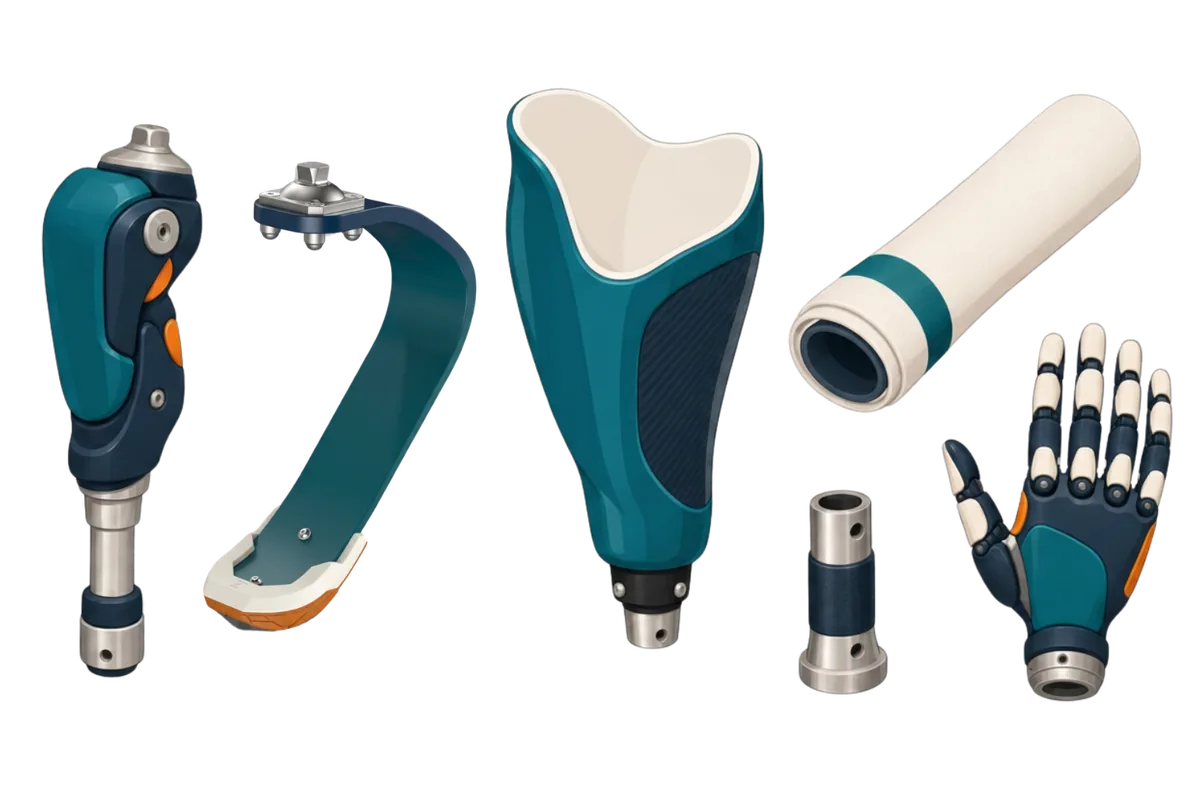
The set of parts depends on the amputation level. Every lower limb prosthesis has a socket, suspension, a shank and a foot. A knee is added wherever the natural knee joint has been lost, and sometimes there are shock absorbers, rotation adapters and other parts that make alignment easier.
Prosthetic socket
The socket connects the residual limb to the rest of the prosthesis and carries the whole of your body weight into it. Comfort depends on it. So does control over the prosthesis.
A socket is to the residual limb what a boot is to the foot on a long hike. The best sole is useless if the boot pinches, and after ten kilometres nobody is thinking about the sole any more, only about the rubbed heel. A prosthesis is exactly the same. The most expensive knee and the best foot will not make up for a badly fitted socket.
The shape of the socket depends on the anatomy of the residual limb, the state of the skin and soft tissue, the length of the residual limb and what the user wants to do on the prosthesis. A 2022 review of socket design by Wang and colleagues shows that fitting problems are among the most common reasons people struggle to use a prosthesis. You do not have to put up with pain in the socket. It is a signal to go back to your prosthetic clinic, and if the pain is stabbing or feels like an electric shock, to a doctor as well, because the cause is sometimes a neuroma.
Liner and prosthetic socks
Between the skin and the hard wall of the socket there is usually a soft layer. Most often it is a liner, a sleeve of silicone or gel pulled straight onto the residual limb. It protects the skin and makes wearing the prosthesis more comfortable. In many systems it also holds the prosthesis on. The word "liner" even appears in Polish regulations, in the names of the benefits that cover replacing one.
Residual limb volume changes during the day. It is often larger in the morning and smaller in the evening, and in the first months after amputation it shrinks clearly and steadily. The difference is made up with prosthetic socks of different thickness.
Suspension
Suspension keeps the prosthesis on the residual limb. It may rely on vacuum created in the socket by a valve, on a pin at the bottom of the liner that clicks into a lock at the base of the socket, on a sleeve pulled over the thigh, or on the shape of the socket itself, gripping the bony prominences.
Each has its advantages. Each also asks something of you, if only hands that work well enough to put the liner on.
Pylon and adapters
In a modular prosthesis the socket, knee, load bearing section and foot are joined by adapters, most often shaped like an upside down pyramid. They let the prosthesis be set to within a few degrees, and the setting has a direct effect on how you walk. The names of the individual connectors will not be any use to you. What will be useful is knowing that a small alignment correction at the clinic can change your gait more than a new foot.
Exoskeletal and endoskeletal (modular) prostheses
In an exoskeletal prosthesis the hard outer shell is also the load bearing structure. It is the older solution, durable and water resistant. Changing the alignment later or swapping the foot, on the other hand, is difficult.
An endoskeletal (modular) prosthesis is built from separate parts joined into one system, usually around a pylon. It can be adjusted and extended, and from the outside it can be covered with a cosmetic cover, a foam shell in the shape of a leg. Both appear in Polish regulations, which use the terms "definitive exoskeletal prosthesis" and "definitive modular prosthesis".
Modular construction does not imply any particular mobility level. It is made both for people who walk mostly at home and for very active ones.
Prosthetic feet
The foot is where the prosthesis meets the ground. It cushions the heel strike, lets body weight roll forward, and depending on its design it adapts to uneven ground or gives back some energy at push off. The Polish Integrated Educational Platform, in materials prepared by Lodz University of Technology and Poznan University of Medical Sciences, divides feet into rigid, flexible, single axis, multiaxial, dynamic and electronic, among others.
Non-articulated foot (SACH)
The simplest design, with no moving ankle joint. The classic example is the SACH foot, where a softly shaped heel absorbs the impact at first contact with the ground. It is light and needs almost no maintenance. It gives back no energy.
Single axis foot
It has one hinge that lets the foot drop flat onto the ground just after heel contact. Getting full contact with the ground quickly gives a sense of stability, which matters especially with an above-knee prosthesis, where the prosthetic knee is safest when the whole foot is on the ground.
Multiaxial foot
It works in several planes, so it adapts better to uneven ground, grass or cobblestones. More axes does not mean better. A foot that moves asks more control from the user, and the choice depends on how you walk, your mobility level, the conditions the prosthesis will be used in and the other parts of the prosthesis.
Energy storing (dynamic response) foot
Dynamic feet have spring elements, most often carbon fibre, that bend under body weight and return part of the stored energy at push off. Hence the name energy storing and returning foot.
This is where promises easily run ahead of the facts. A review of ten studies of people after below-knee amputation found that walking on an energy storing foot costs only slightly less energy than on the simplest SACH foot. The difference was under three percent. It was statistically significant, but the authors judged it too small to matter in daily life. Dynamic feet have their advantages, for instance when you change walking speed or are more active, but do not expect them on their own to make walking stop being tiring.
Hydraulic and microprocessor-controlled ankle-foot
Some feet have a mechanism that lets the ankle angle change, for example on a slope or after switching to shoes with a different heel. In simpler designs the movement is controlled by hydraulics, as in a hydraulic ankle, in more advanced ones by a microprocessor.
The clinical guideline on foot selection says something that surprises many people. Neither age nor the cause of amputation should be the main criterion. What counts is how the person walks and what they need from the prosthesis.
Prosthetic knee
A prosthetic knee is needed after an above-knee amputation, after knee disarticulation and at higher amputation levels. It has to let the leg bend while it swings forward, and at the same time it must not bend while you are standing on it. These two jobs rule each other out, and the whole history of prosthetic knees is a history of searching for a compromise between them.
The Integrated Educational Platform divides knees by number of axes into single axis and polycentric, and by the way movement is controlled into mechanical, pneumatic, hydraulic and electronic.
Single axis knee
It has one axis of rotation and in its simplest form works like a hinge. Manufacturers add mechanisms to it that increase stability or regulate how fast it bends and straightens.
Polycentric knee
Also called a four bar or multi axis knee, it has several linked axes. The instantaneous centre of rotation moves as the knee bends, which adds stability in the stance phase and makes it easier to swing the leg forward. It also folds more compactly, which matters with a long residual limb.
Locking knee and stance control knee
A knee with a manual lock stays straight while you walk and unlocks only for sitting down. Walking is stiff. But very safe. A stance control knee, sometimes called a weight activated brake knee, works differently, because it resists bending only when the user puts weight on the prosthesis. Both put stability first and are chosen mainly for people for whom an unexpected knee buckle is the biggest risk.
Pneumatic and hydraulic knee
In these knees resistance to movement is regulated by a system filled with air or fluid. A pneumatic knee mainly controls the swing, that is the speed at which the lower part of the prosthesis swings forward. A hydraulic knee can be adjusted over a wider range and can also control the stance phase, for example when going down stairs one step after the other.
The 2019 guideline recommends fluid controlled knees for people who walk a lot, because walking on them is more comfortable, faster and more symmetrical.
Microprocessor knee
A microprocessor knee has sensors that check the position of the prosthesis, the knee angle and the load many times every second. Based on that, the microprocessor changes the resistance of the hydraulic system. One setting for standing, another for brisk walking, yet another for going down a slope, walking on uneven ground or sitting down.
You often hear that it is "a knee that walks by itself". It is not. A microprocessor knee is more like ABS in a car. ABS does not drive for you and does not choose the road, it steps in only when a wheel starts to slip. A microprocessor knee does not take the step for the user either. It makes sure the knee does not bend when it should not, and so that a stumble does not turn into a fall.
The guideline I mention in the previous section says that compared with knees without a microprocessor, microprocessor knees reduce the number of stumbles and falls and the mental effort of walking, meaning how hard you have to concentrate on every step. A 2022 pooled analysis of studies on people with limited ability to walk outside the home also points to fewer falls and better results on selected gait measures. The results concern particular groups of participants, though, and do not mean a microprocessor knee will be right for everyone.
Interim and definitive prostheses
An interim (temporary) prosthesis is used at the start of rehabilitation. In the first months after amputation the residual limb shrinks and changes shape, and the way you load the leg and walk changes too. So a prosthesis from this period does not have to look like the final solution, and its socket usually has to be adjusted or replaced. Polish regulations clearly distinguish temporary and definitive prostheses, among others for below-knee and above-knee levels.
A definitive prosthesis is made once the residual limb has settled and the user's needs are known. The word "definitive" does not mean it will last a lifetime, though. The residual limb keeps changing for years, parts wear out, and the regulation provides, among other things, for replacing the socket and the liner.
More than one prosthesis
The prosthesis you walk on every day does not have to be your only one. Work makes different demands, and so do cycling, running, a particular sport or bathing. A sports prosthesis is built for one kind of movement and that is why it does not replace the everyday one. It simply does something else.
Every additional prosthesis means a separate fitting, learning to use it and keeping it in good working order. So more prostheses do not automatically mean more possibilities.
Mobility level and choice of prosthesis
The Polish regulation uses four mobility levels.
| Level | Description in the regulation, in short |
|---|---|
| 1 | moves indoors on a flat surface with crutches, a cane or a walker and cannot walk without them |
| 2 | walks and gets over small obstacles, moves outdoors to a limited extent |
| 3 | moves independently and without restriction indoors and outdoors |
| 4 | moves without restriction indoors and outdoors and, because of high activity and heavy loads, has additional demands on how active and dynamic the prosthesis is |
This is a Polish national classification. English language literature uses a similar American scale with letter codes, the K-levels, but the two are not equivalents and one cannot simply be translated into the other. In Poland the scale from the regulation applies, and it is the one that decides which prosthesis a prescription can be written for.
The mobility level is only one part of the assessment. Alongside it come the condition of the residual limb, muscle strength, balance, the way the person walks, the conditions they live and work in, and their own expectations. Nor is the mobility level a life sentence, because after rehabilitation it is sometimes higher than at the first assessment.
What the choice of prosthesis depends on
Choosing a prosthesis is an individual process and several people take part in it. The prescription is written by a doctor with the right specialty or by a specialist physiotherapist, the prosthesis is designed and fitted by a prosthetist at a prosthetic clinic, and a physiotherapist teaches you to walk on it. What matters is the level and length of the amputation, the shape of the residual limb and the state of its skin and tissue, the range of movement in the remaining joints, muscle strength, balance, body weight, the kind of ground you walk on, the work you do, the hand function needed to put the prosthesis on, and experience with earlier prostheses.
With the foot, the main things are the need for stability, the ability to change speed and walking on rough ground. With an above-knee prosthesis there is also the choice of knee, where the guideline takes into account how the person moves, walking speed, stability and safety.
Below-knee and above-knee prostheses side by side
| Feature | Below-knee prosthesis | Above-knee prosthesis |
|---|---|---|
| Own knee joint | kept | lost |
| Prosthetic knee | not needed | one of the most important parts |
| What controls knee flexion | the user's muscles | the prosthesis mechanism |
| Complexity of the build | depends on the parts used | usually greater |
| Effort of walking | lower | usually higher |
So the difference is not just the length of the prosthesis. After an above-knee amputation the prosthesis takes over the function of the lost knee, and that changes how it is built and how you control it.
The prosthesis as a system
In practice "prosthetic leg" describes a whole system. One person has a below-knee prosthesis, modular, with a total contact socket, vacuum suspension and an energy storing foot. Another has an above-knee prosthesis, also modular, with a thigh socket, a pin liner, a microprocessor knee and a multiaxial foot. Both will tell their friends "I have a prosthetic leg" and both will be right.
Asking about the type of prosthesis without giving the amputation level and the other parts is therefore too general. That difference is what separates a sensible classification from a product catalogue.
To sum up
Every way of dividing lower limb prostheses starts from the amputation level: foot, ankle, lower leg, knee, thigh, hip, and in a few cases the pelvis. Only then do you describe the construction, exoskeletal or modular, the socket, the suspension, the foot and, where needed, the knee.
Feet differ in the number of axes of movement and in whether they return energy. Knees differ in the number of axes and in how they are controlled, from mechanical through pneumatic and hydraulic to electronic. None of these is best for everybody. It does not have to be. You do not choose a foot on its own, a knee on its own or a socket on its own, but the whole prosthesis, along with its alignment and its fit to the person who will walk on it.
Frequently asked questions
What types of lower limb prosthesis are there?
The basic division follows the amputation level. There are partial foot prostheses, ankle disarticulation prostheses, below-knee prostheses, knee disarticulation prostheses, above-knee prostheses and hip disarticulation prostheses. Each is further described by its construction, socket, suspension, foot and knee.
How does a below-knee prosthesis differ from an above-knee one?
After a below-knee amputation your own knee joint remains and your muscles control bending. After an above-knee amputation the knee has been lost, so a prosthetic knee replaces it and the prosthesis becomes more complex.
What is a prosthetic socket?
It is the part of the prosthesis that holds the residual limb. It connects it to the rest of the prosthesis, carries body weight and gives control over the prosthesis. Comfort depends on how well it fits more than on any other part.
What is an energy storing foot?
A foot with spring elements that bend under body weight and give back part of the energy at push off. Research does not confirm, however, that it clearly reduces the effort of walking.
What is a microprocessor knee?
A prosthetic knee with sensors and a microprocessor that keeps adjusting the resistance of the mechanism to the situation. In the groups of users studied it reduces stumbles and falls.
Does everyone need an interim prosthesis?
An interim prosthesis is the stage before the definitive one. Whether it is used, and in what form, depends on the condition of the residual limb and how rehabilitation goes.
Can I have more than one prosthesis?
Yes. Many people do. Separate prostheses can be used for everyday walking, work, sport or bathing.
Does a higher mobility level mean a particular kind of prosthesis?
No. The mobility level describes how the user is able to move, not how the prosthesis is built. Polish regulations do use it, however, to determine which kinds of prosthesis a prescription can be written for.
What comes next
Next step Choosing a prosthetic practice What the first visit looks like, how to build a working relationship with your prosthetist and what to look for when choosing a provider.- ArticleLighter, more natural materials. What carbon fibre really changes, and what it does not
- ArticleRehabilitation after amputation: what the road looks like, and why it's different for everyone
Got a question? Write to us through the contact form. We answer every message.

Sources
- Minister Zdrowia, Obwieszczenie Ministra Zdrowia z dnia 16 czerwca 2025 r. w sprawie ogłoszenia jednolitego tekstu rozporządzenia Ministra Zdrowia w sprawie wykazu wyrobów medycznych wydawanych na zlecenie, Dz.U. 2025 poz. 1038. eli.gov.pl
- Integrated Educational Platform (Zintegrowana Platforma Edukacyjna), teaching materials on prosthesis design and the selection of lower limb prosthesis components, Lodz University of Technology and Poznan University of Medical Sciences. zpe.gov.pl
- Stevens PM, Rheinstein J, Wurdeman SR. Prosthetic Foot Selection for Individuals with Lower-Limb Amputation: A Clinical Practice Guideline. Journal of Prosthetics and Orthotics. 2018;30(4):175-180. DOI: 10.1097/JPO.0000000000000181. pmc.ncbi.nlm.nih.gov
- Stevens PM, Wurdeman SR. Prosthetic Knee Selection for Individuals with Unilateral Transfemoral Amputation: A Clinical Practice Guideline. Journal of Prosthetics and Orthotics. 2019;31(1):2-8. DOI: 10.1097/JPO.0000000000000214. pmc.ncbi.nlm.nih.gov
- Wang M, Nong Q, Liu Y, Yu H. Design of lower limb prosthetic sockets: a review. Expert Review of Medical Devices. 2022;19(1):63-73. DOI: 10.1080/17434440.2022.2020094. pubmed.ncbi.nlm.nih.gov
- Gardiner JD, Bari AZ, Howard D, Kenney LPJ. Transtibial amputee gait efficiency: Energy storage and return versus solid ankle cushioned heel prosthetic feet. Journal of Rehabilitation Research and Development. 2016;53(6):1133-1138. DOI: 10.1682/JRRD.2015.04.0066. pubmed.ncbi.nlm.nih.gov
- Hahn A, Bueschges S, Prager M, Kannenberg A. The effect of microprocessor controlled exo-prosthetic knees on limited community ambulators: systematic review and meta-analysis. Disability and Rehabilitation. 2022;44(24):7349-7367. DOI: 10.1080/09638288.2021.1989504. pubmed.ncbi.nlm.nih.gov