

Materials · 12 min read
Lighter, more natural materials. What carbon fibre really changes, and what it does not
Artur Wąsowicz · September 1, 2026
My prosthesis weighs less than the leg it replaced. For the first few months I felt the opposite. When I started reading up on where that gap comes from, it turned out the material is only half the answer.
Disclaimer: this text describes materials and what the research says about them. It is not a guide to choosing components. Which socket, which liner and which foot suit you is settled by your prosthetist together with your doctor, after looking at your residual limb and talking about how you live.
What the thing is made of
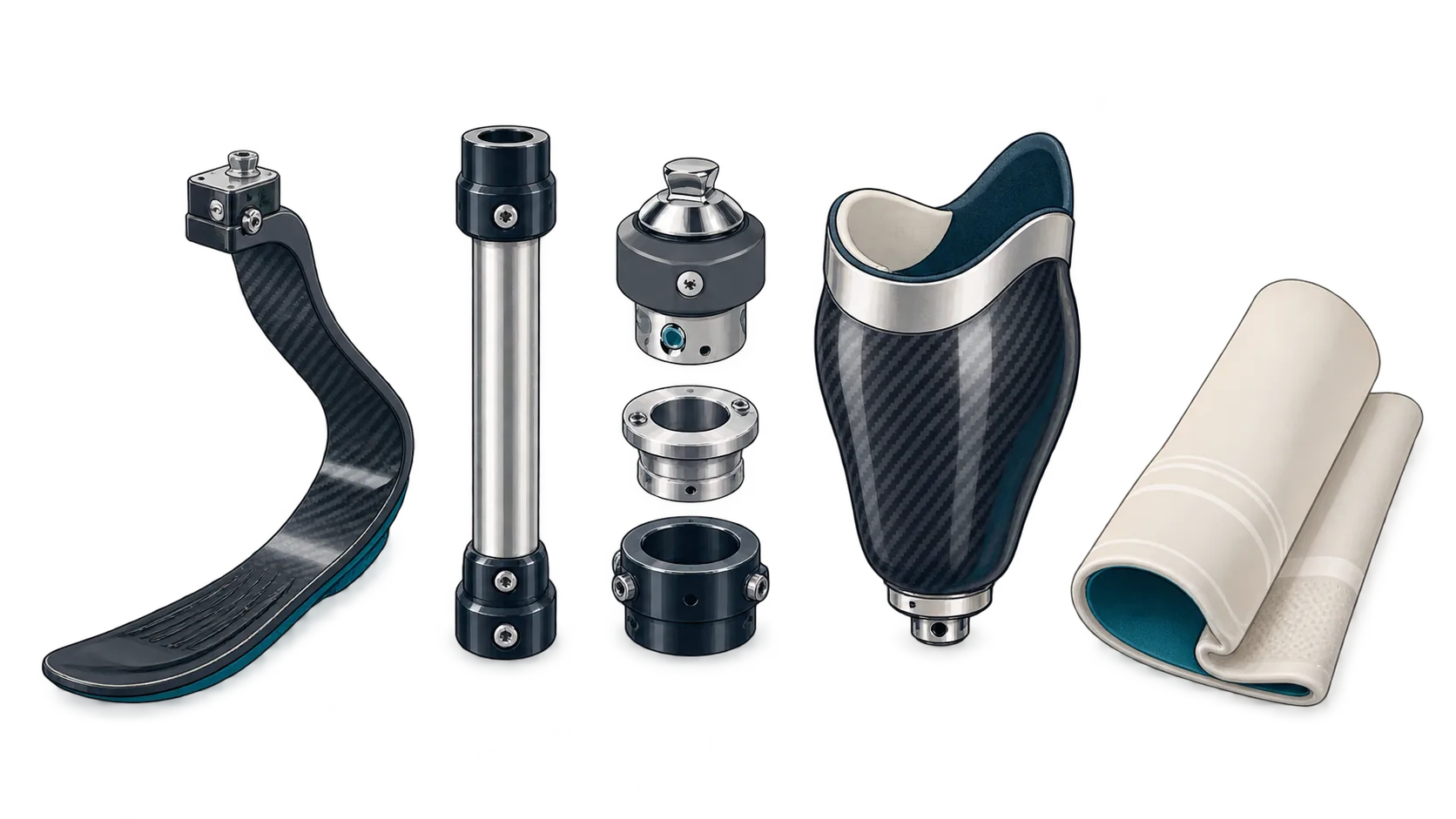
Let me start by taking it apart, because without that the rest makes no sense. An above-knee prosthesis is not one object made of one material. It is six layers, each from a different substance, each there for a different reason.
| Part | Material | Why that one |
|---|---|---|
| Liner on the residual limb | silicone, polyurethane or thermoplastic elastomer | a soft layer between skin and a hard socket |
| Socket | carbon and glass fibre laminate on resin, sometimes thermoplastic | has to hold its shape and not crack under full load |
| Knee | aluminium or plastic housing, hydraulics inside (plus electronics in microprocessor prostheses) | this is where the whole control mechanism sits |
| Pylon | titanium, aluminium, carbon fibre | joins knee to foot, carries the entire load |
| Adapters | titanium, steel, aluminium | small parts that hold the whole thing together |
| Foot | carbon or glass fibre spring (plus electronics in microprocessor prostheses) | stores and returns the energy of a step |
| Cosmesis | foam, silicone, plastic cover | appearance, protection from dirt and water |
One thing follows from that. There is no such thing as a carbon fibre prosthesis. There is a prosthesis in which carbon fibre does two specific jobs: it holds the socket and it works as a spring in the foot.
What carbon fibre is for
The answer is: not to make things lighter. Lightness is a side effect, not the aim.
The spring in the foot has to do something odd. Give way under body weight at heel strike, store energy inside itself, return it at toe off, and repeat that millions of times. ISO 10328 sets out a fatigue test for foot and ankle assemblies running to three million cycles, reproducing the loads of ordinary walking. A metal that would survive that many cycles at that deflection would be either too stiff or too heavy. Carbon composite can reconcile the two, because it has very high stiffness relative to its mass and takes repeated bending well.
In the literature these feet are called ESR or ESAR, from energy storage and return. Storing energy and giving it back. That is not a marketing name, it is a description of the function.
What the spring cannot do
A study published in 2017 states plainly that ESR feet without an additional joint have a markedly smaller range of ankle movement than a human foot, and that in standing alone the spring is loaded at roughly half of what it takes in walking. That is where the trouble with standing on slopes comes from.
The second thing, which gets talked about rarely. A 2024 study shows that most passive ESR feet are stiffer than a biological ankle, particularly at slow walking speeds, and return less energy than a human leg. For comparison, in that same paper a typical lightweight passive foot weighs 463 grams and the variable-stiffness prosthetic joint under test weighs 945 grams. Twice as much. And it was the heavier one that gave the better biomechanical results.
Newer does not mean better
Here comes my favourite result in this whole field.
In 2021 a comparison was published between a carbon fibre foot and a composite foot on glass fibre. Glass fibre is cheaper, heavier and has a reputation as the poorer material. In the study the glass fibre foot gave a greater range of dorsiflexion, higher generated power at the ankle and greater energy absorption. Energy return came out the same. And the participants rated their quality of life with a prosthesis higher with that foot.
A single study settles nothing, and I am not claiming glass fibre is better. I am claiming something narrower. The name of the material on the leaflet does not tell you how the foot will behave under you. That is decided by the geometry of the spring, the lay-up of the plies and the match of stiffness to your weight and activity. The material is a starting point, not a result.
Why titanium is not everywhere
Titanium has a good strength-to-weight ratio and does not corrode. If mass were the only thing that mattered, a prosthesis would be made entirely of it. It is not, and the reason is not price.
The reason is called ISO 10328. It is the standard describing structural testing of lower limb prostheses. It defines loading levels labelled P3 to P8, assigned to bands of user body mass: P3 below 60 kilograms, P4 below 80, P5 below 100, P6 below 125, P7 below 150 and P8 up to 175. On top of that come two loading conditions, one reproducing the moment at heel support, the other at forefoot support. The tests are both static and fatigue, because some failures come from one bad step and some from a million ordinary ones.
A manufacturer has to pass the test for the level it declares. If a titanium adapter does not pass P6 for someone weighing 120 kilograms, a steel one goes in. Heavier, and that is a deliberate choice, not an oversight. When your prosthetist tells you a lighter part cannot go there, this is usually what they mean.
Worth asking about
Ask your prosthetist for the loading level of the components being proposed to you, and the manufacturer's body mass limit. That information is in the product datasheet. If you are near the upper limit, it changes the choice of parts more than anything else does.
Is a lighter prosthesis a better one
Everybody assumes so. I assumed so too. The research says otherwise, and this is the most interesting part of the subject.
In datasheets, the mass of a below-knee prosthesis usually falls between half a kilogram and two. The leg it replaces, in someone weighing 70 kilograms, is about four kilograms. So the prosthesis is two to eight times lighter than what it replaced. People after an amputation nevertheless report that it feels heavy. A study published in Current Biology in 2021 took up exactly that mismatch and showed that restoring sensation through nerve stimulation lowers the perceived weight of the prosthesis. The weight did not change by a single gram. What changed was how far the brain accepted the prosthesis as its own.
Further on. A randomised double-blind study was run in which ten people with above-knee amputations had identical-looking weights added to their prostheses: 150 grams, 770 grams and 1625 grams. A two-minute walk test showed no meaningful difference between the three. More than half of the participants preferred the loaded prosthesis to the lightest one.
A systematic review from 1999 went further still. The authors set theoretical models against experimental work and wrote that the inertia of today's lightweight prostheses does not need reducing, and that sometimes it needs increasing.
Where the mass sits, rather than how much of it there is
There is, though, one result that puts order into this mess, and it bears directly on the choice of parts.
In a 2022 study, fourteen people with above-knee amputations had 1.8 kilograms added at three points on the prosthesis: just above the knee, halfway down the shank and just above the foot. The mass was the same every time. The results were not.
Loading just above the foot raised metabolic cost, lowered walking speed and deepened the asymmetry of stance time. Loading above the knee and halfway down the shank made nothing worse.
That changes the question. It is not about how much the prosthesis weighs, it is about where that mass sits. Every gram at the end of a pendulum costs many times more than a gram at the hip, because what counts in pendulum motion is the moment of inertia, and that grows with the square of the distance from the axis. Which is why manufacturers fight for grams in the foot, while in the knee they can afford hydraulics, a battery and electronics.
The practical conclusion is this. If somebody offers you a component 200 grams heavier but functionally better, ask where those 200 grams will end up. Above the knee you probably will not feel it. In the foot you will.
The liner, the material that touches skin
The liner gets talked about less than the foot, and it is the liner that decides whether you feel like putting the prosthesis on at all. There are three materials, plus gels on mineral oil.
Silicone. The stiffest and most elastic of the three, in compression, shear and tension. Durable. Holds its shape well. It has a high coefficient of friction against skin, meaning it grips firmly.
Polyurethane. It flows. That is, the gel moves out of areas of higher pressure into areas of lower pressure, so it spreads load more evenly. It has the lowest friction of the three. Worth thinking about for a residual limb with scarring and prominent bone.
Thermoplastic elastomer. The softest, the best at cushioning. At the cost of durability.
There is one more detail that is not on the leaflet. The fabric on the outside of a liner can raise tensile stiffness by more than two hundred per cent. That fabric is what limits pistoning, the movement of the residual limb inside the socket with every step. Two liners made from the same gel, one with fabric and one without, will behave completely differently.
And the thing that surprised me most. The thermal conductivity of all three materials is similar, and close to that of tanned leather. None of them carries heat away. When it gets wet under the liner in summer, that is not a fault in your particular one. It is the physics of a material nobody has replaced yet.
What follows from this for me
Three things that changed the way I look at datasheets.
First. Marketing sells the material, the user feels the construction. Carbon fibre in a cheap foot and in a sports foot is the same name and two different objects.
Second. Lightness is a conditional virtue. It is worth fighting for in the foot and in the lower part of the shank. Higher up it stops counting, and insisting on it can cost you function.
Third, and for me this is the important one. The perceived weight of a prosthesis is not a measurement of the weight of a prosthesis. When the leg feels like a block of wood, it is more often about socket fit, suspension and how much of the leg you can feel than about grams. Swapping a part for a lighter one will not fix a socket that does not hold.
What is still missing
This section is called Innovations, so let me also say what is not there.
There is no liner material that carries heat away. There is no spring that changes its own stiffness without a motor and a battery, although variable-stiffness prostheses are already being studied. There is no cosmesis that looks like skin and stands up to daily use at the same time.
Additive manufacturing in titanium and in plastics is coming into sockets and load-bearing parts, but in Poland today that means isolated cases, not a reimbursement standard. When I have measured it on my own skin, I will write about it separately.
Pass it on
Know someone who could use this text? Send it to them.
What comes next
Next step Directory of manufacturers, distributors and prosthetic clinics Ottobock, Össur and other manufacturers: contacts, specialisations and component ranges in one place.- ArticleChanging residual limb volume. Why a prosthesis holds better in the morning than in the evening
- ArticleResidual limb care in the first weeks. What I learned in practice
- ArticleUpper limb prostheses. How they are classified and where their names come from
Got a question? Write to us through the contact form. We answer every message.

Sources
- Polish Committee for Standardization, „PN-EN ISO 10328:2016-09. Prosthetics - Structural testing of lower-limb prostheses - Requirements and test methods”, 2016 – sklep.pkn.pl (paid standard, issued in English only)
- Ikeda A.J., Hurst E.J., Simon A.M., Finucane S.B., Hoppe-Ludwig S., Hargrove L.J., „The impact of added mass placement on metabolic and temporal-spatial characteristics of transfemoral prosthetic gait”, Gait & Posture (2022) – sciencedirect.com
- Meikle B., Boulias C., Pauley T., Devlin M., „Does increased prosthetic weight affect gait speed and patient preference in dysvascular transfemoral amputees?”, Archives of Physical Medicine and Rehabilitation (2003) – sciencedirect.com
- Preatoni G., Valle G., Petrini F.M., Raspopovic S., „Lightening the Perceived Prosthesis Weight with Neural Embodiment Promoted by Sensory Feedback”, Current Biology (2021) – cell.com
- Cagle J.C., Reinhall P.G., Hafner B.J., Sanders J.E., „Characterization of Prosthetic Liner Products for People with Transtibial Amputation”, Journal of Prosthetics and Orthotics (2018) – journals.lww.com
- Rogers-Bradley E., Yeon S.H., Landis C., Lee D.R.C., Herr H.M., „Variable-stiffness prosthesis improves biomechanics of walking across speeds compared to a passive device”, Scientific Reports (2024) – nature.com
- Kaufman K.R., Bernhardt K., „Functional performance differences between carbon fiber and fiberglass prosthetic feet”, Prosthetics and Orthotics International (2021) – ovid.com
- Selles R.W., Bussmann J.B., Wagenaar R.C., Stam H.J., „Effects of prosthetic mass and mass distribution on kinematics and energetics of prosthetic gait: a systematic review”, Archives of Physical Medicine and Rehabilitation (1999) – sciencedirect.com
- Ernst M., Altenburg B., Bellmann M., Schmalz T., „Standing on slopes - how current microprocessor-controlled prosthetic feet support transtibial and transfemoral amputees in an everyday task”, Journal of NeuroEngineering and Rehabilitation (2017) – jneuroengrehab.biomedcentral.com