

Prosthesis types · 17 min read
Upper limb prostheses. How they are classified and where their names come from
Artur Wąsowicz · October 4, 2026
At the clinic you will hear about myoelectric, cable-operated and passive functional prostheses. At first it is easy to get lost. The chart below divides them into three branches and two separate groups. Choose any field and you will read what it means.
Disclaimer: this text sorts out the names of prosthesis types. It is not a fitting. Which prosthesis suits you in particular is something you settle together with your doctor and your prosthetist at a prosthetic clinic.
How to read this division
The chart has three branches that do not exclude one another, and two separate groups. The amputation level tells you which part of the limb the prosthesis replaces. Function tells you whether the prosthesis has something you control while moving, or whether you set its parts with your other hand. Control type applies only to active prostheses, because it describes where the energy for movement comes from and how you pass on the command. A passive prosthesis has no command at all.
So one prosthesis usually carries two or three names at once. A forearm prosthesis can be active and myoelectric at the same time. An upper arm prosthesis can be passive and functional. When the clinic simply says "myoelectric", the word refers only to the way of control. It says nothing about the amputation level or about the terminal device at the end of the prosthesis.
Some of these names have a very concrete origin. The terms "passive cosmetic prosthesis", "passive work prosthesis with a work terminal device" and "active prosthesis" are the literal wording, translated here, of entries in the Polish Minister of Health regulation on medical devices issued on prescription. The regulation is the basis on which NFZ, the Polish public health insurer, funds prostheses, and the doctor uses the same words on the prescription and the clinic on its quote. In English-language literature the second one is usually called a passive functional prosthesis. The two groups below the chart, hybrid and adaptive, I describe separately at the end.
Upper limb prostheses
Amputation level
- Hybrid (passive and active, with an outside or own power source)
- Unclassified "adaptive prostheses" for developmental, educational, work and sports activities
Division based on a chart by Szymon Janicki, MSc.
Amputation level
This branch answers the simplest question, namely what is missing. The higher the amputation, the more joints the prosthesis has to replace, the fewer of your own movements remain to operate it, and the more weight rests on the residual limb or on the trunk. That is a tendency, not a rule. The length of the residual limb, the state of the skin, muscle strength, scars and what someone wants to use the prosthesis for can shift the choice either way.
Finger prostheses
They are used after the loss of one or several fingers, whole or in part, with the rest of the hand intact. Most often you will come across a silicone finger prosthesis, slipped onto the residual finger like a thimble and held in place by a precise fit. The clinic can tint it to your skin tone, with a nail and creases at the joints, but the prosthesis itself does not actively bend.
The second route is mechanical finger prostheses. Their joints are linked so that movement of the remaining part of the finger, or of the joint at its base, bends the whole prosthesis. The energy comes from your own movement. In the language of the chart it is an active body-powered prosthesis. It makes sense only when the remaining part has movement and strength that can be passed on to the prosthesis.
That is why so much depends on what is left. A residual finger with preserved sensation is valuable in itself, because the skin of the fingertip gives information no prosthesis can reproduce. Sometimes the better choice turns out to be a prosthesis that leaves this skin uncovered, or covers it only for certain tasks. Whether a cosmetic version is possible, a mechanical one, or neither, depends on the level and nature of the loss, and the prosthetist assesses it together with the doctor.
The Polish regulation has no separate entry for finger prostheses. The hand group contains one entry, a passive cosmetic prosthesis within the hand, so it is worth asking about funding for a specific solution already at the prescription stage.
Partial or whole hand prostheses
This level begins where part of the metacarpus is missing and ends at wrist disarticulation, when the whole hand is gone but the forearm bones remain intact. After partial loss of the hand the prosthesis has to fit next to what is left and must not block anything.
A preserved wrist is especially valuable. In some designs it is the bending and straightening of the wrist that closes and opens the mechanical fingers of the prosthesis, so a movement the brain has always known becomes control. After wrist disarticulation forearm rotation usually remains, turning the palm down and up, and a socket shaped to the end of the residual limb can pass this rotation on to the prosthesis.
This level has its price too. The residual limb after wrist disarticulation is long, so little room is left for mechanisms, and a powered prosthesis can end up longer than the other arm. Cosmetic, work and body-powered mechanical prostheses are used here, and in some systems fingers driven by separate small motors.
Forearm prostheses
The residual limb ends between the wrist and the elbow. Clinically this is a transradial amputation, and the prosthesis a transradial prosthesis. A preserved elbow is a big asset, because it positions the hand in space by itself, at the mouth, at the table, at the pocket. The prosthesis does not have to replace it. It only has to leave it free. The longer the residual limb, the more forearm rotation usually remains and the longer the lever you have. A short residual limb gives less rotation and less surface for electrodes.
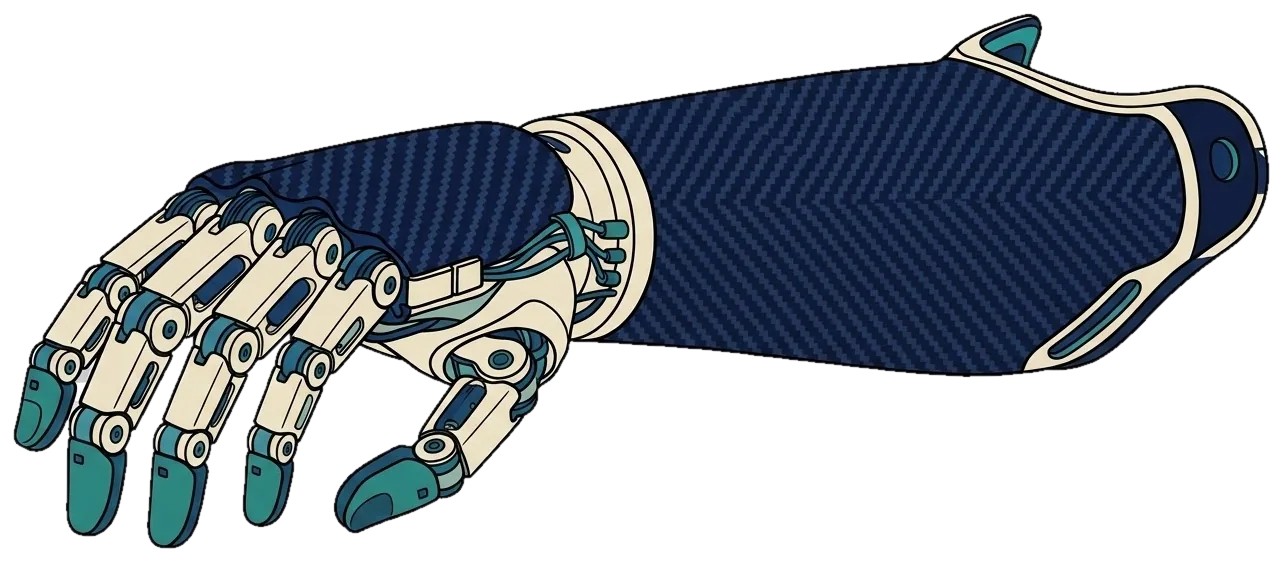
A typical forearm prosthesis consists of a socket, suspension, a wrist unit and a terminal device. The socket encloses the residual limb and transmits force. The suspension holds the prosthesis on the arm. It can be the shape of the socket gripping above the condyles of the humerus, a liner, which is a soft sleeve rolled onto the residual limb, or a harness. The wrist unit lets you rotate the terminal device, by hand or with a motor, and in many designs also swap it for another one. The terminal device may be a hand, a hook or a gripper.
At this level practically every control type described below can be used. For the forearm the Polish regulation lists three basic entries, passive cosmetic, passive work and active, and separately replacement of the suspension of an active forearm prosthesis. That shows well how big a role this part plays.
Upper arm prostheses
The residual limb ends above the elbow, within the humerus. Clinically this is a transhumeral amputation, and the prosthesis a transhumeral prosthesis. The prosthesis then replaces two joints, the elbow and the hand, and often wrist rotation as well. Losing your own elbow changes a great deal, because the prosthetic hand has to be not only opened and closed but first brought to where it is to work and locked in that position.
There are more joints to operate and fewer sources of control. In a classic body-powered prosthesis one cable can first bend the elbow and, once the elbow is locked, open the terminal device, while the lock is switched with a separate shoulder movement. In a myoelectric prosthesis the signal usually comes from the biceps and triceps, so the user switches between controlling the elbow and controlling the hand, because two muscles are not enough to operate both joints independently at the same time. The details depend on the system.
Weight matters more too. The weight of the hand acts at the end of a long lever, and every gram added at the hand loads the shoulder more than the same gram at the elbow. That is why at this level passive and active parts are often combined, for example a mechanical elbow with an electric hand. In the Polish regulation the entry is called an active prosthesis with a work terminal device within the upper arm with a mechanical elbow, and the funding limit treats an active mechanical prosthesis separately from other active prostheses.
Shoulder prostheses (whole upper limb)
They are used after shoulder disarticulation and after an amputation that also removes the shoulder blade and collarbone, called forequarter amputation. The prosthesis then replaces the shoulder, elbow, wrist and hand. It rests on the trunk, on a frame the Polish regulation calls a shoulder cap, and the trunk takes its whole weight.
Suspension, weight and control become the main challenge here. The cap covers a large area of the body, so it can get hot in summer, and every extra part is felt on the shoulder blade and the ribs. Few sources of control remain. Movement of the shoulder girdle on the amputated side, movement of the other shoulder, sometimes expansion of the chest. The shoulder joint of the prosthesis is usually passive, meaning it is positioned with the other hand or swings freely and is held by adjustable friction.
The design depends on the exact level and on which movements are left. Some people choose a lighter and simpler prosthesis than technology would allow, and some use only a shoulder filler that restores the line of the shoulders under clothing. Each of these choices makes sense as long as it fits the everyday life of the particular person.
By function
The second branch of the chart divides prostheses into passive and active, and passive ones further into cosmetic and functional prostheses. You will find the same division in the Polish regulation, where the functional type is called a work prosthesis on medical devices issued on prescription. Besides the prostheses themselves the regulation also lists a cosmetic glove, a passive cosmetic hand and a passive work gripping terminal device. These are parts that wear out and are replaced separately.
Passive (cosmetic)
Their main job is to restore the look and outline of the hand. They have no parts you control while moving. The fingers may be rigid or have a flexible core that lets you set them in a chosen position with your other hand.
They are not useless, though. With such a prosthesis you can hold down a sheet of paper, press an object against the table, steady yourself when getting up, carry a bag hung over the forearm. The prosthesis also fills the sleeve and restores the silhouette, which for many people matters at work and in contact with others. That is a fully legitimate aim of fitting, not an extra.
The look depends on the material and on how it is made. Mass produced gloves are chosen from ready sizes and shades. Custom gloves, usually silicone, can be hand tinted to your skin colour, with veins, freckles and nails. One limitation remains. Movement of such a prosthesis always comes from something outside it, your other hand, the table, a wall.
Passive (functional)
Instead of a hand they have a task-specific terminal device. It can be a hook, a ring for holding handlebars or handles, a tool holder, a flat piece for support, or a passive gripper that you open with your other hand and a spring closes. The regulation calls this last one a passive work gripping terminal device.
The terminal device is set by hand and stays in that position, often thanks to a unit with adjustable resistance or a lock. In many designs it can be quickly detached and replaced with another, so one prosthesis serves several tasks. Looks take a back seat here. What counts is strength, resistance to knocks and dirt, and whether the terminal device really suits the task you do most often.
What such a prosthesis can do depends above all on the type of terminal device. A hook works well for carrying and lifting, a handle holder for garden work, while at a desk the same prosthesis gives you little beyond support. So before talking about terminal devices it is worth writing down a few specific tasks the prosthesis is meant for.
Active (with controlled moving parts)
An active prosthesis has moving parts that you control while carrying out a task. The grip opens and closes on your command, without help from the other hand, and in some designs the elbow also bends or the wrist rotates on command.
The word "active" alone does not tell you where the force comes from or how you give the command. An active prosthesis can be mechanical and pulled by a cable, it can have a motor and electrodes, it can combine both. The Polish regulation actually provides for this distinction. For active upper arm and whole upper limb prostheses it gives one limit for an active mechanical prosthesis and another for other active prostheses. The way of control is described only by the third branch of the chart.
Control type
Before I move on to the individual types, one remark without which it is easy to get lost in this branch. Every active prosthesis needs two things. Energy to perform the movement, and a command that decides when and what movement should happen. The source of energy is power, the way the command is passed on is control. The chart divides prostheses mainly by power, while the name "myoelectric" refers to control. That is why a motor in the hand can be directed by a muscle signal, a button or a pressure sensor, and each time the energy comes from the same battery.
Body-powered (own source)
Here the energy comes from the movement of your body. Most often it is pushing the shoulders forward or moving the arm away from the trunk, transmitted to the prosthesis by a harness and a cable.
The harness is worn over the shoulders. In the classic version it crosses on the back in a figure of eight and rests against the armpit on the other side. Attached to the harness is a cable running in a housing, much like a bicycle brake cable. When you push your shoulders forward, the distance between your back and the terminal device grows, the cable tightens and pulls the grip mechanism, and when you relax the movement a spring or rubber bands return the terminal device to its starting position.
There are two basic arrangements. In the first, cable tension opens the grip and a spring closes it, so grip force depends on the spring. In the second, cable tension closes the grip and you squeeze as hard as you pull. Which one suits you better depends on what you want to hold and for how long.
For such a prosthesis to work you need enough range of movement in the shoulder girdle and enough strength to overcome the resistance of the mechanism. In return the cable lets you feel how hard you are squeezing and what position the grip is in, so the prosthesis gives back some of the information your eyes do not. No motor and no battery means no charging and fewer parts that can fail in tough conditions. It does not mean no maintenance, because cables wear and rubber bands and springs weaken over time.
The 2015 systematic review by Carey and colleagues, covering 31 studies selected from 462, found that body-powered prostheses came out better on durability, training time, frequency of adjustment, maintenance and feedback. The limitation remains the harness itself, which can rub and press on the armpit, and the need to make a clear shoulder movement that others can see.
Externally powered (outside source)
The energy comes from a source outside the body. Today it is almost always a battery and an electric motor. In the past it was sometimes compressed gas, and in research designs also a pump forcing fluid. Your body does no mechanical work here. It only gives the command.
The command takes various forms. It can be a muscle signal picked up by electrodes, pressing a button, pressure on a sensor in the socket, or pulling a cable that this time does not move the grip but flips a switch. The chart lists four kinds of externally powered prosthesis. Electric, myoelectric, pneumatic and hydraulic. Three of them are named after the drive and one after the way of control, so the borders between them are not sharp, and every myoelectric prosthesis is at the same time electrically driven.
Electric
In an electric prosthesis a motor does the movement, usually combined with a gearbox that turns fast rotation into slow and strong movement of the fingers or elbow. The energy comes from a battery, most often built into the socket or the forearm of the prosthesis and charged much like a phone. The control electronics receive the command and decide which motor to start, in which direction and for how long, and in many systems they also make sure the grip does not exceed a set force.
The hand or gripper, wrist rotation and, in upper arm prostheses, the elbow can all be electrically driven. You give the command with a button, a pressure sensor in the socket, a switch pulled by the harness, and in some systems with a muscle signal.
An electric prosthesis does not have to be myoelectric. "Electric" refers to the drive, "myoelectric" to where the command comes from. Switch control can be the answer where the muscle signal in the residual limb is too weak or too hard to separate, and for people who prefer simpler operation.
Myoelectric
A muscle that contracts produces a weak electrical signal. It is the same signal a doctor examines in electromyography, hence the abbreviation EMG. It arises in muscle fibres stimulated by a nerve and reaches the skin, where it can be measured, although it is very weak and counted in microvolts and millivolts.
In a myoelectric prosthesis the electrodes are built into the socket wall and rest on the skin over chosen muscles of the residual limb. In a forearm residual limb these are usually the muscles that bend and straighten the wrist, in an upper arm residual limb the biceps and triceps. The electrode puts nothing into the body. It picks up the signal from the skin surface, amplifies it, cleans it of interference and passes it to the controller.
The controller compares the signal with a set threshold. In the simplest two electrode setup contracting one muscle opens the hand and contracting the other closes it. In many systems this works proportionally, so a stronger contraction gives a faster or stronger movement. The command goes to the motor, which moves the fingers, wrist or elbow. Changing the grip type is done, depending on the system, by contracting both muscles at once, by a series of short pulses, by a button on the prosthesis or by a phone app.
The quality of contact between electrode and skin decides whether the prosthesis obeys. Sweat, a socket that is too loose, a change in residual limb volume during the day, even a different arm position can make the electrode lose the signal or pick up a false one. So the socket of a myoelectric prosthesis has to keep the electrodes in the same place all the time, in every arm position, and whether the prosthesis will be used later depends largely on the prosthetist's work.
The other half of the work is yours. You have to learn to contract the muscles repeatably, each one separately, with the right force and without looking at the residual limb. Usually you start with exercises on a device that shows the signal on a screen, often before the prosthesis is even made, and later you train specific tasks with a physiotherapist or an occupational therapist. The number and type of available movements depend on the system, from a simple gripper with one opening and closing movement to hands with many programmed grips.
Some systems use several electrodes placed around the residual limb and software that learns to recognise the activity pattern of the whole muscle group, not just the strength of two muscles. In some cases this allows more natural control, but it needs calibration and is not standard in every myoelectric prosthesis.
This is the group where the word "bionic" comes up most often. It is a popular and marketing term, not the name of a category in the chart or in the Polish regulation. It usually refers to prostheses with electronics, sensors and many grip types, but there is no single definition saying when a prosthesis becomes bionic. Science uses the word broadly too. A German review from 2006, titled after bionic arm prostheses, covers designs with various drives, hydraulic ones included.
The review by Carey and colleagues credited myoelectric prostheses with a better rating for appearance, a favourable effect on phantom pain and greater acceptance for light work. The same studies, however, did not make it possible to establish which system is functionally better, because the comparisons gave conflicting results. In a commentary on this review Linda Resnik pointed out that nearly 60 percent of the included studies were rated as being of low methodological quality. So the choice between a body-powered and a myoelectric prosthesis should come from your needs and the conditions you work and live in, not from a belief that one of them is simply better.
Pneumatic
Movement comes from compressed gas, usually carbon dioxide from a replaceable cartridge. The gas flows through valves to actuators which, as they expand, move the grip, the elbow or wrist rotation. The valves were most often opened by movement of the shoulders and trunk, so the energy came from the cartridge and the command from the body.
Such prostheses were developed mainly in the 1950s and 1960s. In Heidelberg Ernst Marquardt's team was working on them before the thalidomide tragedy, and when many children were born with congenital limb deficiencies between 1958 and 1962 the work picked up pace. The Heidelberg experience was drawn on in Edinburgh and London among other places, where children were fitted with prostheses driven by carbon dioxide cartridges.
Today you rarely come across them in clinics. A 1978 paper already noted that where people had started with pneumatic solutions they were moving to electric drive. The Science Museum in London, describing such prostheses, mentions the hiss of gas during movement and the unreliability of the whole system, and the cartridges had to be replaced regularly.
Hydraulic
Movement comes from fluid under pressure. A pump forces it through a closed circuit into small actuators that expand and move a joint, and when the pressure drops the part returns to its starting position. Fluid makes it possible to deliver force where it would be hard to fit a motor with a gearbox.
In hand prostheses hydraulics appears mainly in research designs. A well documented example is the hand developed in the early 2000s at a research centre in Karlsruhe together with the orthopaedic clinic in Heidelberg. It had a miniature electrically driven pump, flexible actuators in the finger joints and two electrodes in the socket, so in the language of the chart it was hydraulic, electric and myoelectric at once. Its designers stressed that the fingers stay soft and adapt to the shape of the object being gripped.
In everyday upper limb fitting this is a rarity. Do not confuse it with lower limb prostheses, where hydraulics is common in knees, because there it mainly damps and brakes movement rather than drives it.
Hybrid
Hybrid prostheses combine different ways of working in one design. The chart describes them as passive and active, with an outside or own power source, so they can combine a passive part with an active one, body power with external power, or both at once.
A typical example is an elbow bent by a cable from the harness, or set by hand and locked in a chosen position, together with a hand moved by a motor and controlled by a muscle signal. The reverse combination is also found, an electrically driven elbow and a cable-operated terminal device. Not every hybrid prosthesis looks like this, because there are many possible combinations.
They matter most at higher amputation levels. With an upper arm or shoulder prosthesis there are more joints to operate than sources of control, and every motor with a battery adds weight on a long lever. A hybrid lets you operate one joint with body movement and another with a motor, and keep the weight reasonable. The authors of the 2017 update of the Carey review noted that research on hybrid prostheses is only just gathering pace.
Adaptive prostheses
They do not fit into any of the three branches, which is why the author of the division marked them separately as unclassified. In English-language literature they are usually called activity-specific prostheses. They are made for a specific activity that an everyday prosthesis cannot handle, or handles badly.
An everyday prosthesis is a compromise, because it has to cope with dressing, eating, work and going out. An adaptive solution gives up this versatility for one activity. It can be a terminal device for bicycle handlebars, a barbell, a golf club, an oar or for swimming. It can be a tool holder fitted to a particular workstation, a holder for a bow or a guitar pick, a terminal device for a camera or a fishing rod.
For children adaptive prostheses serve play, learning and development, that is cycling, climbing, drawing, playing ball. For adults they more often serve work, sport and hobbies. They are not a single design. Sometimes it is a swappable terminal device fitted to the socket of the everyday prosthesis in place of the hand, and sometimes a separate prosthesis with its own socket, built for loads an ordinary prosthesis would not withstand.
Summary
The chart by Szymon Janicki, MSc, sorts upper limb prostheses into three independent branches and two separate groups. The full name of a prosthesis comes from combining the branches that apply to it, for example an active myoelectrically controlled forearm prosthesis or a passive functional upper arm prosthesis with a hook.
| Criterion | What does it describe? | Examples |
|---|---|---|
| Amputation level | Which part of the limb the prosthesis replaces | finger, hand, forearm, upper arm, shoulder |
| Function | Whether parts of the prosthesis are controlled during movement | passive cosmetic, passive functional, active |
| Control type | Where the energy comes from and how the command is passed on | body-powered, electric, myoelectric |
| Hybrid design | A combination of different ways of working | mechanical elbow and electric hand |
| Adaptive use | Fitted to a specific activity | sport, work, education, music |
None of the types described is the best overall. Each works better or worse for particular tasks, for a particular person and in particular conditions, and it also happens that one person uses several prostheses, one for the office, another for the clinic.
Frequently asked questions
How does a passive prosthesis differ from an active one?
A passive prosthesis has no parts you control while moving, and you change its position with your other hand. An active prosthesis has moving parts that open, close or bend on your command.
How does a mechanical prosthesis differ from a myoelectric one?
In a body-powered mechanical prosthesis the energy comes from shoulder movement transmitted by a cable. In a myoelectric prosthesis a battery powered motor does the movement, and the command comes from the electrical signal of contracting muscles in the residual limb.
Is an electric prosthesis always myoelectric?
No. An electric prosthesis has a motor, but the command can be given with a button, a switch or a pressure sensor. We call it myoelectric only when the command comes from a muscle signal.
Can one person use several types of prosthesis?
Yes. Some people use a myoelectric prosthesis every day, a passive functional prosthesis for physical jobs and an adaptive one for sport, and each of them needs its own fitting.
What does the choice of prosthesis type depend on?
On the amputation level and the state of the residual limb, on the movements and muscle strength you have, on what you want to do with the prosthesis, where you work and live, and on your priorities, such as looks, weight or ease of use. You make the decision together with your doctor and prosthetist.
Does a myoelectric prosthesis need training?
Yes. You have to learn to contract chosen muscles repeatably and to switch grips, and then practise specific tasks, ideally with a physiotherapist or an occupational therapist.
What is a hybrid prosthesis?
It is a prosthesis that combines different ways of working, for example an elbow moved by a cable from the harness and a hand driven by a motor. It is especially useful in amputations above the elbow.
What comes next
Next step Choosing a prosthetic practice What the first visit looks like, how to build a working relationship with your prosthetist and what to look for when choosing a provider.- ArticleLighter, more natural materials. What carbon fibre really changes, and what it does not
- ArticleRehabilitation after amputation: what the road looks like, and why it's different for everyone
Got a question? Write to us through the contact form. We answer every message.

Sources
- Obwieszczenie Ministra Zdrowia z dnia 16 czerwca 2025 r. w sprawie ogłoszenia jednolitego tekstu rozporządzenia Ministra Zdrowia w sprawie wykazu wyrobów medycznych wydawanych na zlecenie, Dz.U. 2025 poz. 1038 (groups E and F). api.sejm.gov.pl
- POLMED, Polish Chamber of Commerce of Medical Devices, „Kategoryzacja wyrobów medycznych do zaopatrzenia indywidualnego”, 1st edition, Warsaw, January 2016. polmed.org.pl
- Carey S.L., Lura D.J., Highsmith M.J., „Differences in myoelectric and body-powered upper-limb prostheses: Systematic literature review”, Journal of Rehabilitation Research and Development, 2015, 52(3), pp. 247–262, DOI 10.1682/JRRD.2014.08.0192, PMID 26230500. pubmed.ncbi.nlm.nih.gov
- Carey S.L. et al., „Differences in Myoelectric and Body-Powered Upper-Limb Prostheses: Systematic Literature Review Update 2013–2016”, Journal of Prosthetics and Orthotics, 2017. olc.oandp.org
- Resnik L., „Improving the Quality of Evidence on Upper-Limb Prostheses Through the Standardization of Outcome Measurement”, Journal of Prosthetics and Orthotics, 2017, 29, pp. P21–P24. olc.oandp.org
- National Academies of Sciences, Engineering, and Medicine, „Upper-Extremity Prostheses”, chapter 4 in: „The Promise of Assistive Technology to Enhance Activity and Work Participation”, Washington, 2017. ncbi.nlm.nih.gov
- Marquardt E., „Special Considerations: The Multiple-Limb-Deficient Child”, in: Atlas of Limb Prosthetics, American Academy of Orthopaedic Surgeons, 2nd ed., 1992. oandplibrary.org
- „Externally Powered Upper-Limb Prostheses”, Clinical Prosthetics and Orthotics, 1978, 2(1). oandplibrary.org
- BMJ, obituary of David Simpson, 2006, 333:150. bmj.com
- Science Museum Group, pair of CO2 gas powered artificial arms, Roehampton 1963, object record. collection.sciencemuseum.org.uk
- Pylatiuk C. et al., „Two multiarticulated hydraulic hand prostheses”, Artificial Organs, 2004, 28(11), pp. 980–986; Pylatiuk C., Döderlein L., „Bionic arm prostheses: State of the art in research and development”, Der Orthopäde, 2006, 35(11), pp. 1169–1175. Project publication list: iai.kit.edu
- MIT Technology Review, „Upgrading the Prosthetic Hand”, 2008. technologyreview.com