Five programmes, one channel
YouTube channel
The Świat Bioniki video channel will not be one stream of random films. From the outset we are planning it as five separate series, each answering a different question and addressed to someone else. One person is looking for specific information about a component. Another wants to see that a normal life is possible again. Someone else is still waiting for surgery and has no idea what next week holds.
Each planned programme is described below.
Prosthesis for Real
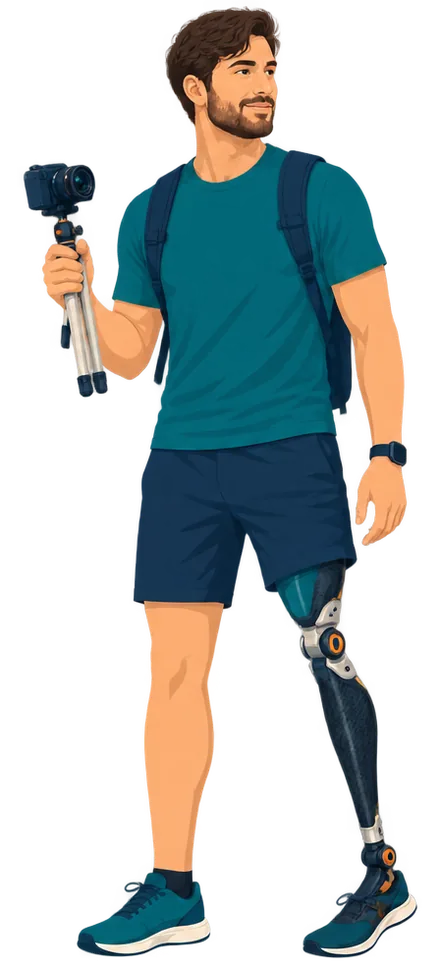
I test prosthetic components in the conditions I use them in myself. Not in a laboratory, not on a treadmill wired to sensors, but on the stairs of a block of flats, on wet cobbles, getting into a car and ten hours into a day on my feet.
I do it for a simple reason. Manufacturer materials show how a component behaves when everything goes well. A person after amputation needs to know what happens when it goes badly. How the prosthesis reacts to a stumble. How long it takes to learn a new mode. Whether after a month you still want to use it.
I have an amputation at thigh level and I walk every day on a microprocessor knee. That is not a neutral observer position and I do not pretend it is. I have my own habits and my own body weight, and that changes the experience. So in every episode I say where I am looking from, so the viewer can translate it onto themselves.
One important caveat, which I repeat in every film. These are user tests, not clinical trials and not gait analysis. I do not measure torque or energy expenditure. I describe what it is like to use.
What it will cover
- prosthetic knees and feet in everyday use, over a longer period
- sockets and liners, which is where every day begins
- equipment for sport and activity, with a description of the conditions I tested it in
- the things that failed, because those need saying too
Independence
I accept no payment from manufacturers or distributors for material in this programme. If a component reaches me on loan for testing, I say so plainly at the start of the episode. The assessment is not subject to arrangement with anyone.
People of Bionics
Conversations with people after amputation. No stirring music and no tales of triumph over adversity.
I have been an amputee long enough to know how that particular narrative works. Two weeks after surgery someone watches a film about a person running marathons and, instead of motivation, comes away feeling worse. That is not what we are after. What interests me is what lies in between. The first time in a shop. The conversation with an employer. The moment you stop checking whether anyone is looking.
The guests will differ. One went back to manual work, another did not and built life differently. One is happy with their prosthesis, another cannot stand it. All these stories are true and all of them are needed.
We are not persuading anyone of anything. If after watching an episode someone thinks it went differently for them, that is fine. It goes differently for everyone.
What it will cover
- the first months, told without retouching
- going back to work, to driving, to being a parent
- family and loved ones, the side most often forgotten
- what nobody said earlier, and should have
An invitation
If you would like to tell your story, write to us. You do not need anything to prove.
Write to usStep by Step
Five modules leading through the whole process, from the first days after amputation to the point where the prosthesis stops being the topic of the day.
This programme is above all for people just entering this road, and for those close to them, whether the amputation was planned or came suddenly after an accident. The order matters, because in the first weeks after amputation nobody needs a lecture on types of knees. They need to know what is happening to their residual limb this week and what comes in a month. People who have lived with a prosthesis for years will find their topics in the modules on formalities and funding, because the next prosthesis often means walking the same path again.
The modules run as follows: the perioperative period, residual limb shaping and the first prosthesis, learning to walk, formalities and funding, return to independence. Each is several short episodes rather than one long recording.
The material will be consistent with the texts in the Life after amputation section, so that you can move between reading and watching depending on what you have the strength for.
What it will cover
- what actually happens in the weeks after surgery, week by week
- who to talk to and what to ask, so as not to lose time
- the formal path in Poland, from the certificate to the prescription and funding
- the most common mistakes of the first months, mine included
Disclaimer
This material is educational and does not replace consultation with a doctor, prosthetist or physiotherapist. Every case is different.
Map of Polish Prosthetics
Sixteen voivodeships and an attempt to answer the question that comes up most often: where to have a prosthesis made.
How it works. After the official launch of the portal I send workshops an invitation to take part in the programme. I build the list from recommendations by people after amputation, contacts in the community and component distributors, who know best where the equipment actually goes. Participation is voluntary and depends solely on the workshop.
Travel and production are financed by the foundation. The workshop does not pay to take part, has no influence on the edit and does not approve the material before publication. This is not advertising.
Until the invitations go out we name no one, because nobody has confirmed anything yet, and putting someone on a list without their consent would be dishonest.
What we will show on site: what a workshop looks like from the inside, how measurements are taken, how long making a socket really takes, which components are available and what service looks like when something breaks on a Friday afternoon.
What it will cover
- workshops in successive voivodeships, one or several per region
- conversations with prosthetists about what is possible under reimbursement and what is not
- real timescales, real costs, without rounding towards optimism
- what to ask before deciding, so offers can be compared on the same data
Bionics of Tomorrow
Coverage from trade fairs, conferences and industry meetings. Technologies that Poland only starts talking about once they go on sale, and which are worth knowing about earlier.
This programme has the loosest calendar, because it depends on event dates rather than on us. When something significant appears, we travel and record. When there is nothing, we do not record for the sake of it.
One question interests us: how much of this will actually reach a patient in Poland, and when. A university prototype looks impressive on film and sometimes spends ten years without leaving the laboratory. We will say so honestly, including when the answer is “probably never”.
What it will cover
- new components and control systems, shown without the marketing wrapper
- solutions already available in Europe but not yet in Poland
- conversations with engineers and researchers
- telling what works apart from what looks good in a presentation
Why this division
These five programmes were not invented around a table during planning. They came out of questions I have been getting for years, ever since people realised they could ask me.
Some questions are technical and about equipment. Others are about whether life will be normal. A third kind comes from parents and partners rather than the person concerned. A fourth comes down to where to go. A fifth comes from those who already know everything about their prosthesis and want to know what comes in five years.
It is hard to answer all of them in one format. Hence five separate ones.