

Residual limb care · 8 min read
Residual limb care in the first weeks. What I learned in practice
Artur Wąsowicz · September 7, 2026
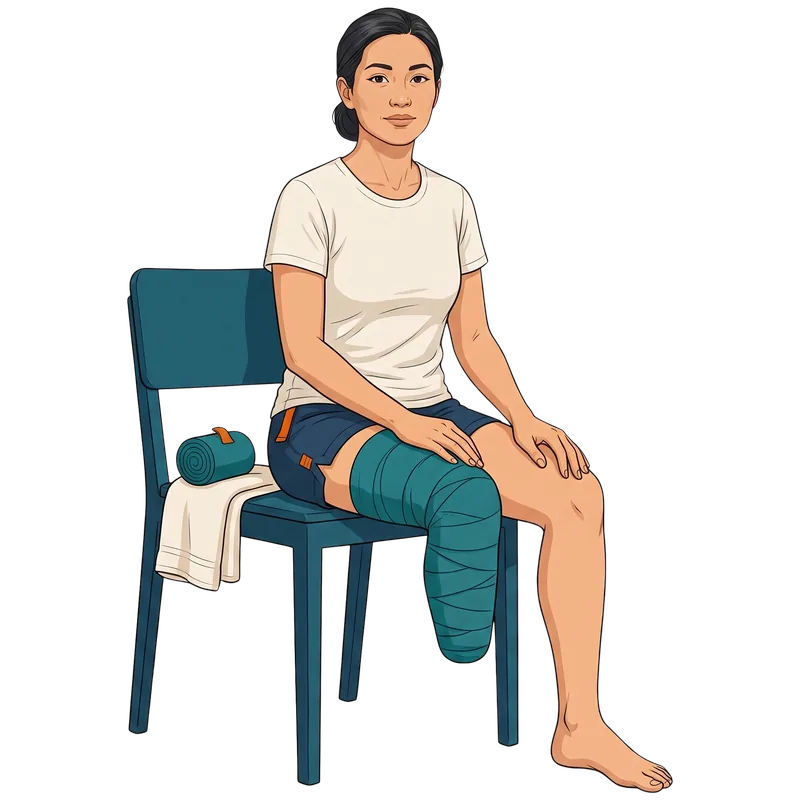
I left hospital with a list of instructions. The limb hurt so much that it was hard even to touch. My wife took over the care and the desensitisation, because my right arm was in a cast.
Disclaimer: this text describes my own experience and generally accepted guidance. It does not replace a medical consultation or hands-on instruction from a physiotherapist. What happens after an amputation depends on its cause, its level and your general health, so always follow what your own treating team tells you.
I left hospital with a list of instructions. The limb hurt so much that it was hard even to touch. My wife took over the care and the desensitisation, because my right arm was in a cast.
The instructions handed to you at discharge are short and, by their nature, general. Nobody can put every situation of the coming weeks on a single sheet of paper. The rest you learn at home, usually by trial and by asking questions at the next check-up.
In my case one more thing made everything harder. For the first six months I had to wear a brace just to sit upright, and my right wrist was immobilised in a cast. Which means that even if I had badly wanted to look after the limb myself, I physically could not.
My wife is a nurse, so she did it better than I would have, and she knew what to watch for. I write this straight away, because I am aware it is not a typical situation. Most people after an amputation do not have someone at home with that kind of training.
If you are reading this on your own, or the person caring for you has no medical background, your situation is harder than mine was. That does not mean you cannot get through it. It means it is worth asking for hands-on instruction before you are discharged, and not being shy about phoning with questions when something starts to worry you.
Touch hurts, and that is normal
The first thing that genuinely surprised me was how much an ordinary touch hurt. It was not the wound itself. The whole area was hypersensitive, and the lightest brush against the skin could hurt out of all proportion to what was actually happening.
There was also something I could not name at the time. When the limb was touched, I felt the touch in two places at once. Where my wife's hand actually was, and somewhere further down, in the part of the leg I no longer had. It was not phantom pain in the classic sense, but sensation referred elsewhere.
Honestly, it unsettled me back then. Today I know I am not alone with it, because I have heard similar descriptions from other people after amputations. I wrote more about how phantom sensation differs from phantom pain and from residual limb pain in a separate text.
I only noticed one thing after a while. When I touched the limb myself, it hurt noticeably less. I do not think my wife was doing it worse. I suspect that when you do something to yourself, you are adjusting the pressure the whole time and you know what comes next. With someone else's hand that is missing. So if you are able to do part of it yourself, it is worth doing, if only for that one reason.
Hygiene, the basics and nothing beyond them
Washing the limb daily with soap and water and drying it thoroughly is the instruction repeated by every serious Polish source. The state e-textbook, prepared by a team from Lodz University of Technology and Poznan University of Medical Sciences, lists exactly the same, adding mild soaps and toners intended for residual limb care.
Before I go further, one note. As long as the wound has sutures and a dressing, you wash the skin around it, in line with what the doctor advised, not the wound itself. Full washing of the limb starts only once it has healed.
A few things we learned in practice, and to my mind those matter most.
The water should be lukewarm rather than hot, because skin after surgery reacts differently than usual.
Dry by pressing the towel against the skin, not by rubbing. At this stage every bit of friction is one stimulus too many.
The drying has to be thorough before you put anything on. Moisture under a bandage or under a liner is a straight road to macerated skin.
The person doing the care washes their hands too. It sounds obvious, but on the tenth repetition of the day it tends to get skipped.
Skin and scar
The surgical scar and the end of the limb are the most sensitive parts in the first weeks. They are the ones that will later be in contact with the prosthetic socket, and they will carry the load when you walk.
Moisturising the skin and massaging the scar apply to a healed scar, that is, after the sutures come out. Before that you put nothing on the wound on your own initiative.
Moisturising makes sense, with one caveat that is easy to forget. Do not use a greasy balm right before putting on a bandage or a socket, because the skin has to be dry. Otherwise everything slides and irritates.
Dressings you change exactly as the doctor advised. After the sutures come out the approach changes, and that is a moment for a question to the doctor, not for your own conclusions.
Swelling, and where compression comes from
The limb is swollen after surgery, and that is a normal response of the body, one that subsides with time. That does not mean its volume settles down. It keeps changing for months, even within a single day, which I cover in the article on variable stump volume.
Compression, meaning bandaging or a post-operative liner, is introduced a few days after surgery if there are no contraindications. There is one caveat here, and it applies to a large share of people after amputations. In Poland a large proportion of lower limb amputations have a vascular cause. If the reason for the amputation was limb ischaemia, or if you have diabetes, then when to start compression and how firm it should be is decided by the doctor, not by you and not by the person caring for you. This is not a formality on paper. It is something that can do harm.
The e-textbook lists the aims of compression, that is, reducing swelling, reducing painful phantom sensations, lowering the skin's sensitivity to pressure and touch, making the scar more pliable, and shaping the limb.
That last one matters more than it seems at first, because the shape of the limb decides what kind of socket can be made. The target shape is a cylinder or a tapering cone. A bulbous limb, wider at the end, makes fitting a prosthesis harder.
I am deliberately not describing bandaging techniques here. That is a subject for a separate text, and more importantly it is a skill you have to learn from a physiotherapist or a nurse in person, not from a description. The e-textbook I cite above recommends the same, since in its authors' view the patient should be taught correct bandaging by a qualified person.
I will mention only one thing, because the question comes back very often. Besides the bandage there are shrinker socks and silicone post-operative liners. Their advantage is not comfort, it is repeatability. A bandage goes on slightly differently every time, whereas a liner gives the same pressure at every application.
Whatever you put on, the rule is the same. Compression must not hurt, must not numb, must not change the colour of the tissues. If it does, you take it off and put it on again, because a bandage pulled tight does more harm than good.
Desensitisation
Desensitisation is preparing the limb for what comes later, that is, for constant contact with a socket, for pressure and for friction. It starts once the wound has healed.
The standard recommendation is graded and looks like this:
- alternating warm and cold showers
- rubbing the limb with a sponge, soft at first, then progressively rougher
- rubbing with a towel and fabrics of increasing coarseness
- brushing, from a soft brush to a firmer one
- tapping and massage
- axial loading, that is, resting the limb against surfaces of gradually increasing hardness
For the last point the e-textbook gives a rough reference. After four or five weeks the patient should be able to hold full load on the limb on a hard surface unaided.
I was given exactly the same. It sounded like a set of home remedies, and for a long time that is what I thought. It turns out not, because the same list, in the same order, is in a state teaching resource prepared by medical universities.
My problem was a completely different one. Residual limb pain and phantom pain were strong enough that I simply had no appetite for desensitisation, and there were days when it was not possible at all.
So I am not going to write that all you have to do is your daily bit, because it is not always doable. If you are having one of those days, you let it go and come back the next. That is not a failure and not lost time. It is a normal part of this period.
When to call the doctor
This part is the most important in the whole text.
The e-textbook lists the complications that occur after an amputation, that is, wound infection, wound dehiscence, skin necrosis and swelling. Contact your doctor if you get:
- spreading redness or warmth around the wound
- discharge, especially cloudy or foul-smelling
- pain that intensifies from day to day instead of easing
- a fever above 38 degrees or chills
- the edges of the wound coming apart
- tingling, numbness, coldness or a bluish colour after compression is applied, which does not go away once it is removed
- pain, swelling or redness in the other, non-operated leg
None of these is anything to be ashamed of, and none of them proves you did something wrong. Healing complications simply happen, and caught early they are usually easy to bring under control. Caught late they can be serious.
How I learned bandaging
The care on the orthopaedic ward I went to after intensive care was genuinely very good, and I have nothing to fault it for.
Bandaging a residual limb, however, is a narrow skill, and there are not many people after amputations on an orthopaedic ward. I got no instruction and we had to manage on our own.
At discharge I was given printouts with bandaging diagrams, and that was my starting point. The rest my wife and I looked for ourselves, that is, instructional videos, descriptions, anything that could be fitted to my situation. She knew what to look for as a nurse, and I know how to find information.
A few days after I left hospital a pandemic was declared and practically everything shut. There was no option of driving over to a physiotherapist and asking about anything. We were left with those printouts and with whatever we found online ourselves. We had to manage on our own.
Today it is different. Access to information is wider, there is more material and it is of better quality. The state e-textbook, with an illustrated bandaging sequence and with video sequences, is available free to anyone, and you will find the link in the sources at the bottom of the page.
So if nobody in your hospital shows you bandaging, that is no reason to panic. It is just worth knowing that the material itself can be found, and asking for instruction where someone can demonstrate it in person. A physiotherapist or a prosthetic clinic are the natural first addresses.
Pass it on
Know someone who could use this text? Send it to them.
What comes next
Next step Amputation Navigator Come back at every stage.- ArticleSwelling and residual limb compression. Bandage, shrinker, liner and when to start
- ArticleContractures after amputation. Why the residual limb settles into flexion and how to prevent it
- ArticlePhantom limb pain. Something that is not there hurts. Where it comes from and what helps
Got a question? Write to us through the contact form. We answer every message.

Sources
- „Wczesne usprawnianie poamputacyjne i nowoczesne techniki hartowania kikuta”, e-textbook, authors from Lodz University of Technology and Poznan University of Medical Sciences – zpe.gov.pl
- Juszczak K., „Model opieki pielęgniarskiej nad pacjentem po amputacji kończyny dolnej”, Pielęgniarstwo Chirurgiczne i Angiologiczne (2020) – termedia.pl
- Spannbauer A. et al., „Specyfika postępowania rehabilitacyjnego u chorych po amputacjach naczyniowych”, Pielęgniarstwo Chirurgiczne i Angiologiczne (2009) – termedia.pl
- Centrum Rehabilitacji Znowu w Biegu, „Amputacja - od czego zacząć po zabiegu?” – znowuwbiegu.pl