
Phantom limb pain · 10 min read
Phantom limb pain. Something that is not there hurts. Where it comes from and what helps
Artur Wąsowicz · July 29, 2026 · updated August 30, 2026
Your foot hurts. You do not have that foot. I know how that sounds, and I know how it feels, because I have had it since the day of the accident. It is one of the strangest things I have ever lived with, and for the first year I did not really understand why it was happening.
A note before you read: this text describes my own experience and what I was able to establish from the research. It is not a substitute for a diagnosis or for a treatment plan agreed with your doctor. Phantom limb pain, residual limb pain and phantom sensation are treated differently, and what applies to you is something your doctor decides, not an article on the internet.
If you have lived with this for years and you are looking for methods you have not tried yet, go straight to the second part: on neuroma, procedures and nerve surgery
Three different things people call by one name
This was the first distinction I failed to make, and it changes everything.
Phantom limb pain is pain located in the part of the limb that is no longer there. Toes, midfoot, heel. It stabs, burns, squeezes, twists, shoots through like current.
Phantom sensation is everything else you feel in the limb that is not there, but that does not hurt. Itching, pressure, temperature, the impression that the leg is lying in an odd position. It can be a nuisance. It can also be funny. Pain it is not.
Residual limb pain, which the literature usually calls stump pain, is pain in what is left. Here you can normally find a cause: a badly fitting socket, a bone spur, inflammation, a neuroma.
These three are treated differently. You can have all three at once. If you tell your doctor that your leg hurts and you leave it at that, you will get treatment that is not quite matched to you.
How many of us it affects
Six people in ten. A 2020 study in which a team from Cape Town pooled research from around the world puts it at 64 per cent. Depending on which group you count, the figure runs from 60 to 68.
I have seen numbers online from fifty to eighty-five per cent, and most of them come with no source attached. This one has one.
What follows from that in practice? That if you have this, you are in the majority. You are not strange, you do not have a mental health problem and you are not making it up. I will write this once and clearly, because I went through it myself: this is not happening in your head in the sense that you are afraid of.
Where it comes from
The honest answer is that nobody fully knows. What is known is quite a lot about where to look.
Three levels get named. The first is peripheral: cut nerves in the residual limb regenerate and form clusters of fibres that can fire signals on their own. The second is spinal: the loss of sensory input from the limb changes the chemistry in the spinal cord. The third is central, meaning the brain.
And here I have to say something you will not read on most pages about phantom limb pain.
For twenty years the standing explanation was that after an amputation the area of the brain cortex serving the lost limb gets taken over by its neighbours, and that this remapping produces the pain. That explanation has been questioned for a decade now. The review by Makin and Flor from 2020 says plainly that an account resting only on remapping in the sensory cortex is incomplete, that cause and effect may run the other way, and that you have to look wider than a single brain area.
I am writing about this because you will meet people who will tell you with full confidence that the brain rewired itself and that is where the pain comes from. That is the version science is backing away from. Nobody has a certain answer, and it is better to know that than to be handed a tidy story.
Why it is stronger in some people
From conversations with other people after amputation a certain picture forms. It looks as though severe phantom limb pain more often affects people who lost a limb in an accident. That is my observation, not a study, and please treat it that way.
When I checked what the research says, though, something more interesting came out.
The same study lists factors that raise the risk, and they fall into two groups. Before the amputation: diabetes as the reason for the operation, no counselling beforehand and, above all, persistent pain. After the amputation, phantom limb pain more often accompanies people who have residual limb pain or non-painful phantom sensation. A traumatic cause does not appear on that list at all.
Now my own story. A road accident, my left leg crushed. I was conscious for about forty-five minutes, until the ambulance arrived. I put a tourniquet on myself and waited. In the ambulance I was given fentanyl, and in hospital, because of how extensive the injuries were, a week in a medically induced coma. The doctor from the pain clinic who took care of me later told me that my pain had become fixed precisely because I had stayed conscious that long.
Set that against the list of risk factors. Forty-five minutes of consciousness with a crushed leg is exactly what persistent pain before amputation means. My doctor told me the truth, only in different words from the literature.
The same list has a second factor on it: no counselling before the amputation. In my case there was no such conversation and there could not have been. The decision to amputate was taken while I was unconscious. That is the situation every one of us after an accident ends up in, and none of the popular material on phantom limb pain even notices it.
It is not that an accident is worse than an illness. With an accident there is almost always long, uncontrolled pain before the operation, and with a planned amputation that pain can be brought under control. This is the difference you can actually do something about when the amputation is planned, and it is worth raising with the anaesthetist beforehand.
My first year
I am not going to dress this up.
I was taking nineteen tablets in a single day. The set included an anticonvulsant used for neuropathic pain, amitriptyline, an opioid and a combined paracetamol and tramadol product. I am deliberately leaving some of the names out, because this is not a prescription. The mix is chosen by a doctor and it looks different for everyone.
Medical cannabis and CBD oil came on top of that. For me those helped least of all. Possibly because I find the smell unpleasant, and with daily use that matters. I know several people for whom those two bring enormous relief. I am writing about both experiences, because selling my own failure as a rule would be dishonest. In Poland medical cannabis is available on prescription only. The rules for issuing the first prescription have changed over the past few years, so confirm the details with your doctor. It is not reimbursed by the public health system. In my case it was prescribed by doctors at the pain clinic.
Now the thing nobody writes about.
That set of drugs loaded my nervous system so heavily that I felt like a zombie. Forming a thought was hard, saying precisely what I wanted to say was hard. There was less pain, and there was less of me. That is a real price, and nobody puts it on the leaflet under possible side effects.
The first meaningful relief came after roughly a year. After that it kept getting better.
In time I managed to come off most of the drugs. And here is one sentence that matters more than the whole list above: coming off happened under the close supervision of the doctor at the pain clinic. Not on my own, not by feel, not because that particular week happened to be a good one. Getting out of a set like that is as much a managed process as getting into it.
What the specialists agree on
In 2021 a study came out in which twenty-seven specialists working on phantom limb pain spent three rounds agreeing on what, in their view, works. They started with thirty-seven treatments. Consensus was reached on seven.
Before I list them, one caveat, and please take it seriously. This is an agreed position of a group of specialists, not a guideline from a scientific society. It came about because there is too little hard evidence to compare these methods against each other in numbers. The authors write plainly that reviews of drug treatments to date suggest the recommended drugs are no more effective than placebo. For methods that do not involve drugs there is little research, although early results for graded motor imagery and mirror therapy are promising. That does not mean those methods do not work. It means nobody has properly proved it yet.
The treatments the experts agreed on:
- Graded motor imagery. A staged programme of work with movement imagery. It starts with practising whether a limb is a left or a right one, then moves on to imagining movement, and the final stage is mirror therapy.
- Mirror therapy. A mirror set so that the reflection of the intact leg takes the place of the one that is gone. A warning: this is not the bathroom mirror and five minutes before bed. A 2025 paper that gathered descriptions of these exercises from several dozen studies shows that the studies differ in length, in frequency and in what is actually done in front of the mirror. That is an argument for working with a physiotherapist.
- Amitriptyline. The only drug in the seven and the only one named. It is the same amitriptyline I mention above in my own set.
- Sensory discrimination training. The areas near the end of the residual limb are touched with materials of different texture, for example cotton and a hook-and-loop fastener. There are only a few studies, and expert agreement on this method was the weakest of the seven.
- Use of a functional prosthesis. Yes, walking on a prosthesis is listed in this study as a treatment for phantom limb pain, not only as a way of getting about. What is meant is a functional prosthesis, one used for walking or gripping, as opposed to a cosmetic one.
- Cognitive behavioural therapy and virtual reality training. These two the experts backed on the strength of their own practice, while acknowledging that there is little scientific evidence behind them.
Two treatments were rejected in that study as ineffective. I am not naming them here, because both concern specific situations and I come back to them in the second part.
On top of that come the simple things every source lists: heat, cold, massage of the residual limb. In my case fatigue and stress clearly make the pain worse, and that much is confirmed by every source I have read. Looking after your sleep is not advice off a calendar. For us it is part of the treatment.
TENS
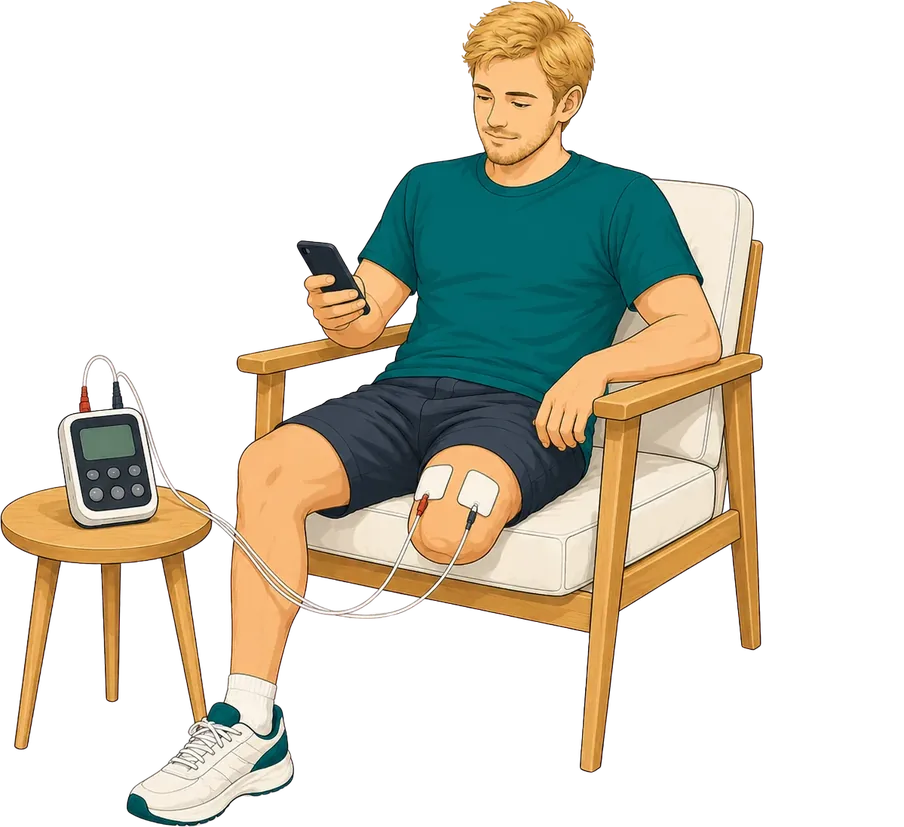
In the photograph at the top of this text you can see a small unit and electrodes stuck to the residual limb. That is TENS, transcutaneous electrical nerve stimulation. The electrodes go on the skin, the unit sends a weak current through them, and underneath you feel tingling. It should be distinct and it should not hurt.
In the study I describe above, TENS was on the list of thirty-seven treatments and did not make the seven. A Cochrane review from 2015 looked for studies with randomised allocation of patients and found none on which you could judge whether this works. That is not the same as saying it does not work. It means nobody has checked it properly. What the weaker work shows is that it is safe and that patients accept it.
For me it helped. I used it in three ways.
Let me start with the one I could not use for a long time, because that is information in itself.
I had a titanium implant with a screw in my residual limb, and with an implant like that you do not stick electrodes over the site. So the most obvious arrangement, TENS directly on the residual limb, was out. Two things are worth adding here, because the question about metal in the body comes up often among us. The absolute ban concerns active implants, meaning a pacemaker, a defibrillator or a pump. With implants such as screws, plates and nails the contraindication is written into the device instructions, although the research does not bear it out, because current from a TENS unit does not heat metal. Do not improvise on your own; ask your doctor or physiotherapist, but know that you have something to ask about.
That left me the two other arrangements, and for all that time they were the ones doing the work.
The first is electrodes on the intact leg, at the spot corresponding to the one that hurts. My phantom calf was what hurt, so the electrodes went on the calf of the other leg. A doctor at the pain clinic put me on to that. It sounds strange, but it was described back in the eighties and it works on a similar principle to mirror therapy. The brain gets a signal from a place it physically cannot come from.
The second is the lumbar spine, the place the nerves to the leg come out of. That arrangement helped me most. I have not found a paper describing it for phantom limb pain, so treat it as my experience and not as a recommendation.
I only started using TENS on the residual limb after the re-amputation, once the implant was gone.
You can buy the unit without a prescription. Before you start, show these settings to a physiotherapist or to a doctor at a pain clinic. Beyond implants there are other situations in which electrodes do not go on, broken skin among them.
Where to start in Poland
One concrete piece of information, because at the beginning this was what I was missing most.
The place you want to get to is called a pain clinic, in Polish poradnia leczenia bólu. You need a referral. It is issued by your GP or by any specialist with a contract with the National Health Fund, the NFZ, which is Poland's public health insurer. The organisational unit code is 1222, or 1223 for a children's clinic. That is the number I saw on my own referrals. It is worth quoting, because it shortens the conversation. A clinic sometimes gives itself a name of its own, say Specjalistyczna Poradnia Leczenia Bólu. What settles whether it is the same kind of unit is the code, not the name.
Waiting times you can check in our pain clinic finder. It shows the clinics contracted by NFZ in the region you pick, together with the waiting time each of them reported to the Fund. The spread between regions and between individual clinics is enormous, so do not go by a single figure found online. Check several clinics, including ones in the next city.
More about Polish practice, about when to go to a neurosurgeon rather than to a pain clinic, and about the procedures available under the NFZ is in the second part.
When the brain accepts a new body
Let me start with a week I should not, in theory, remember.
In the coma I had flashes of awareness: I knew I was in hospital, I was wondering what my life would look like without the leg. One of the first questions I asked my wife after waking was: below or above the knee. She was stunned that I knew at all.
Notice what I was asking about. Not whether the leg was there. About the level. There was no formal conversation before the amputation, yet somehow the preparing happened, without anyone from outside taking part. I write about this mainly for families: a person who is unconscious is not necessarily absent.
Now the thing that surprised me more.
After some six or eight months I started having dreams in which I walked, danced and ran on a prosthesis. Not on two sound legs. On a prosthesis. My brain took on the new body image faster than I expected.
I suspect one thing helped: I had been waiting for that moment badly. The accident also damaged my right leg, my right greater trochanter and my lumbar spine, so I spent around two and a half years in a wheelchair. The prosthesis was not a loss for me. It was a return.
And now the sentence that matters most here. For many people this takes longer. For many it looks nothing like this. If a year on you are still dreaming yourself as you were before the amputation, it does not mean something is wrong with you. It means your road runs at a different pace from mine. I write about my dreams not to set a standard, but so that you know such a moment exists at all.
Part two
In the second part I write about what happens later: where a neuroma comes from and how to recognise it, how radiofrequency ablation differs from cryoablation, what TMR and RPNI surgery are, and what the road to these procedures looks like in the Polish system. Go to it.
Pass it on
Know someone who could use this text? Send it to them.
What comes next
Next step Where to get pain treatment Pick a region and you will see pain clinics contracted by NFZ, with address, phone number and the waiting time each of them reported to the Fund.- ArticleResidual limb care in the first weeks. What I learned in practice
- ArticleRehabilitation after amputation: what the road looks like, and why it's different for everyone
- ArticleLower limb prostheses. Types, structure and selection
Do you have a question about phantom limb pain? Write to us through the contact form. We will not replace your medical team, but we will gladly point you to where to look next.

Sources
- National Health Fund (NFZ), "Waiting times information service" – terminyleczenia.nfz.gov.pl
- Limakatso K., Bedwell G.J., Madden V.J., Parker R., "The prevalence and risk factors for phantom limb pain in people with amputations: A systematic review and meta-analysis", PLoS One (2020) – journals.plos.org
- Limakatso K., Parker R., "Treatment Recommendations for Phantom Limb Pain in People with Amputations: An Expert Consensus Delphi Study", PM&R (2021) – onlinelibrary.wiley.com
- Makin T.R., Flor H., "Brain (re)organisation following amputation: Implications for phantom limb pain", NeuroImage (2020) – sciencedirect.com
- Johnson M.I., Mulvey M.R., Bagnall A.M., "Transcutaneous electrical nerve stimulation (TENS) for phantom pain and stump pain following amputation in adults", Cochrane Database of Systematic Reviews (2015) – cochranelibrary.com
- Limakatso K., McGowan E., Ortiz-Catalan M., "Evaluating Mirror Therapy Protocols in Phantom Limb Pain Clinical Trials: A Scoping Review", Journal of Pain Research (2025) – dovepress.com