
Phantom limb pain · 9 min read
Neuroma, radiofrequency ablation, cryoablation and nerve surgery. What to do when the pain comes back years later
Artur Wąsowicz · July 29, 2026 · updated October 7, 2026
Phantom limb pain can come back after two years, at the point where you think you are done with it. Mine came back, and the cause was a neuroma. This part is about what can be done with that, and about how to reach a doctor in Poland who actually does it.
Disclaimer: I describe procedures I have been through, and methods I have read about in the research. This is not a recommendation of any particular method. Whether there is an indication for a procedure in your case is decided by a doctor after examining you.
If you have landed here directly and you are freshly after an amputation, start with the first part. I explain there how phantom limb pain differs from residual limb pain, and that distinction is needed here.
When it is a neuroma
Nerves cut during an amputation are not simply cut and done with. They try to grow back. The fibres look for the place they were meant to reach, do not find it, and coil into a bundle at the nerve end. That is a neuroma. In the English literature you will usually see it called a stump neuroma.
It forms in everyone. It becomes a problem only when it starts to hurt.
You can recognise it by a few things. The pain is sharp, shooting, often described as electric. You can trigger it by pressing one specific point on the residual limb, always the same one. It gets worse inside the socket. Sometimes you can feel a hard lump under your finger. It appears after months, not straight away.
That last one is the key to understanding the situation. The wound has healed, you are walking on the prosthesis, everything looks fine, and then after a year or two the pain comes back. It is easy to think you did something wrong. You did not. That is the normal course of nerve healing, which in some of us ends in pain.
A neuroma hurts in the residual limb, but it can also sustain and amplify phantom limb pain, the pain in the foot that is not there. That is why treating a neuroma is sometimes at the same time treating phantom limb pain.
My re-amputation
I lost my left leg above the knee in an accident. In the remaining part of the femur I had an intramedullary nail and a screw holding a fractured greater trochanter together.
After almost two years osteolysis set in, a loss of bone tissue at the end of the femur in my residual limb. My orthopaedic surgeon decided to remove the implants, re-amputate and reshape the thigh. I was lucky, I lost only about half a centimetre. But I had to walk the whole road after amputation again from the beginning.
That time the phantom pain did not come back as strongly. There is a but, though.
A re-amputation means cutting the nerves again. After roughly eighteen months a neuroma formed and the strong pain returned. Not the same as right after the accident, but enough to send me looking for a solution again.
I am writing about this for one reason. If a re-amputation or a revision of your residual limb is ahead of you, it is worth talking to the surgeon about the neuroma before the operation, not eighteen months after it. I come back to this under nerve surgery.
The procedures: radiofrequency ablation and cryoablation
These are minimally invasive procedures, the residual limb is not opened, you go in with a needle.
A note on names first. In English these are radiofrequency ablation and cryoablation, sometimes cryoneurolysis. In Poland you will hear termolezja and kriolezja, and those are the words to use in the clinic, so I give them here as well.
Radiofrequency ablation
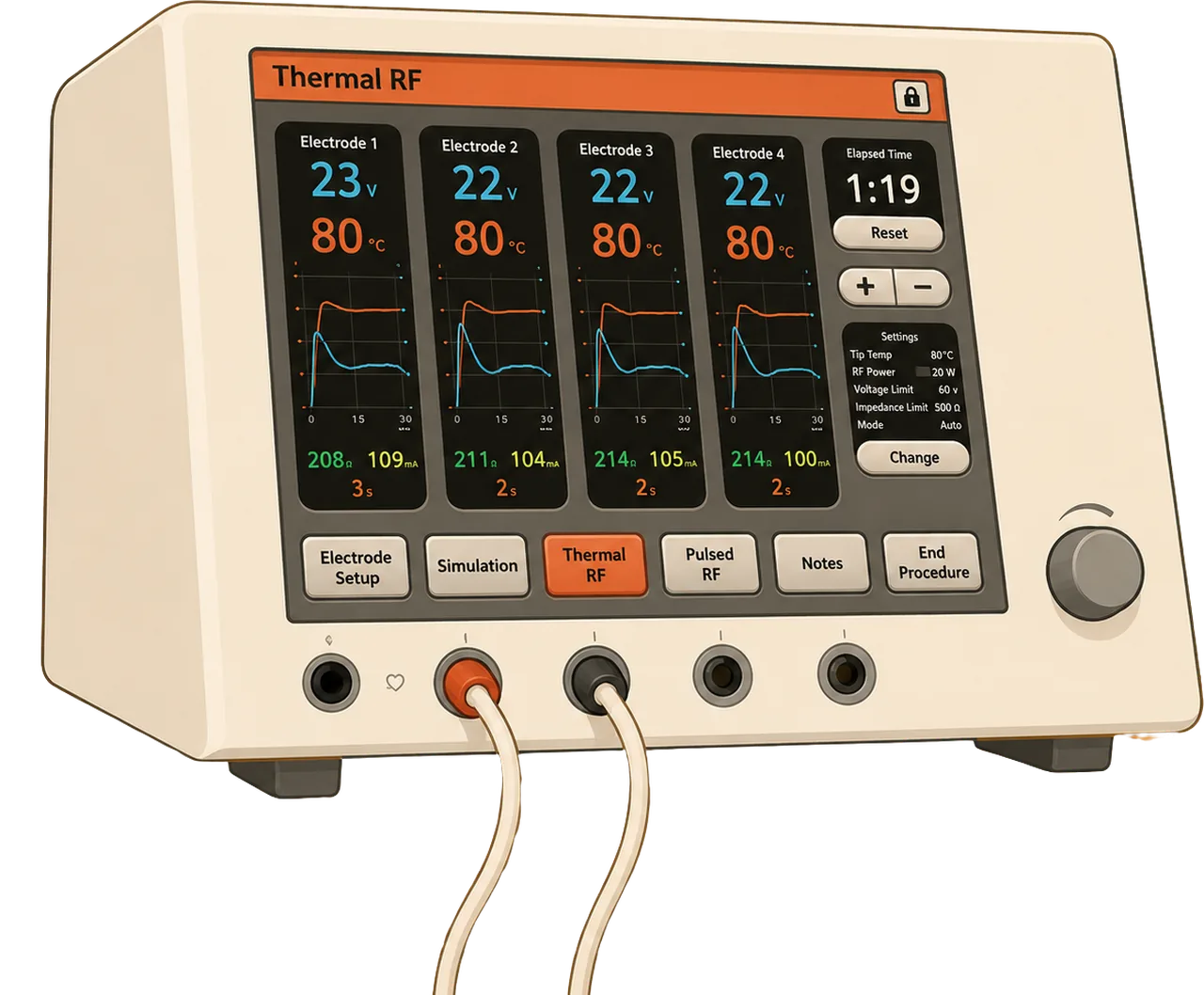
An electrode is introduced through an insulated needle. A high frequency current runs through its exposed tip and produces heat in the surrounding tissue. The neuroma is burned.
There are two variants, and the distinction matters, though it is written about almost nowhere.
Continuous radiofrequency works at around eighty degrees. The nerve is destroyed.
Pulsed radiofrequency works at around forty two degrees, with the current delivered in bursts. The nerve is not destroyed, its excitability is changed. The procedure is gentler, but the effect is usually shorter.
These are two different procedures under one heading. If you are told you are having termolezja, ask which of the two is meant.
Cryoablation
The same principle, the opposite temperature. A very low temperature is delivered through a probe and the neuroma is frozen.
What the research says
Here I have to be honest, because these are not methods with strong evidence behind them.
For ultrasound guided radiofrequency ablation the largest published series covers eighteen people after amputation. Improvement was recorded in sixty nine per cent for phantom limb pain and eighty two per cent for residual limb pain, with twelve months of follow up. These are descriptions of consecutive patients treated, with no comparison against anyone.
For cryoablation it is much the same. Again consecutive patients described, in one paper eight neuromas, with pain falling on average from just over eight to three on a ten point scale and follow up of around twenty seven months.
One caveat from the Delphi study I mentioned in the first part. The experts rejected as ineffective pulsed radiofrequency applied to the dorsal root ganglion. That is not the same as radiofrequency applied to a neuroma in the residual limb, but the difference is subtle enough that you should know which site you and your doctor are talking about.
How it went for me
I have had both procedures, cryoablation and radiofrequency ablation. In my case radiofrequency ablation gave a far better result, and I am currently waiting for the next one.
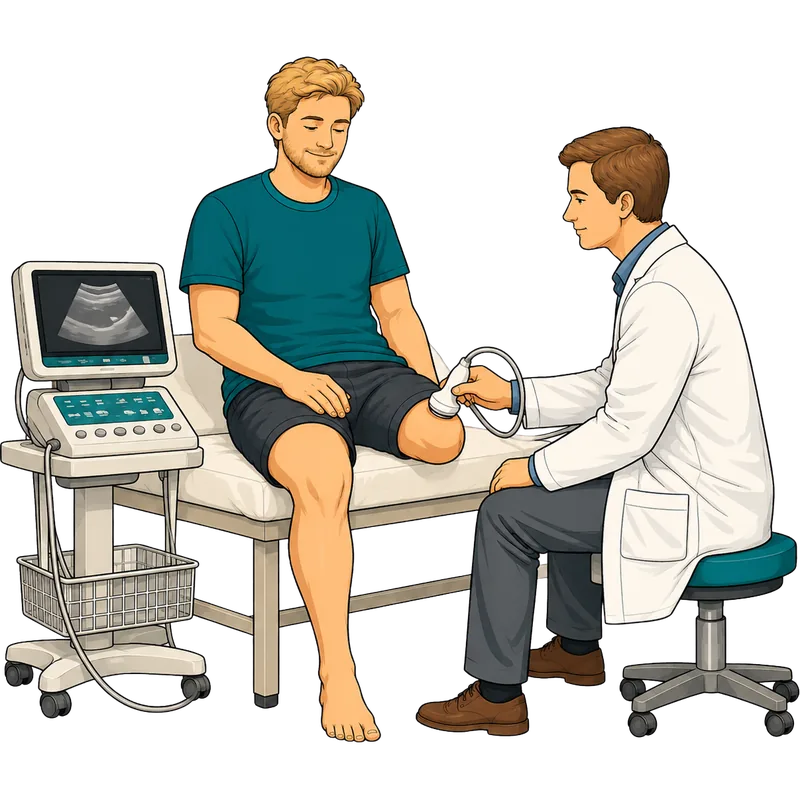
The procedure hurts, but not where you expect it to. The worst part is hunting for the neuroma under ultrasound. I brought the MRI disc with the report and that was not enough. The doctor presses with the probe and checks whether he has hit the spot that hurts. That is the whole point, it has to hurt, because otherwise there is no certainty about what he is aiming at. Once he found it I was given more local anaesthetic and from there it was painless. The cryoablation itself hurt least of everything. In my case, though, it did not work.
This is not evidence, only one case. But since the literature does not settle which method is better, my example has one value: it shows that both are worth trying before you decide nothing works.
Before anything permanent is done, the doctor can inject a diagnostic nerve block at the site of the suspected neuroma. If the pain goes, you know it really is the neuroma. That is a diagnostic procedure and it makes sense to ask for it.
Nerve surgery
Here we move into surgery, and this is where the biggest progress of recent years has been.
TMR
Targeted muscle reinnervation. The cut nerve is transferred into a motor branch of a nearby muscle. It gets a new target instead of looking for the old one and coiling into a neuroma.
This is the method with the best evidence in the whole group. There is a 2019 trial comparing it against standard excision of the neuroma. Who got which operation was decided by randomisation. TMR came out better for phantom limb pain and tended towards better results for residual limb pain.
An extra benefit: the method was originally developed to improve control of a myoelectric prosthesis. For an upper limb that matters enormously.
RPNI
Regenerative peripheral nerve interface. The nerve end is wrapped in a free muscle graft, which gives the fibres somewhere to grow into.
The evidence is weaker than for TMR. These are studies in which operated patients were observed but not compared against anyone, and the studies themselves were rated as poor quality by the authors of the review. The method looks promising particularly as a preventive procedure, done at the time of the amputation itself.
The classic techniques
Excision of the neuroma and burying the nerve stump in muscle or in bone. Transposition of the nerve to a different site. Capping the nerve end.
Pooled results from many studies show clear improvement in around seventy seven per cent of those operated on, with no significant difference between the individual techniques.
The thing that is rarely said
After every one of these operations the nerve will form a new neuroma anyway. Always. That is how nerve healing works.
The whole point of these procedures is that the new neuroma forms in a place where it does not hurt and where the socket does not press on it. This is not a cure in the sense people imagine. It is moving the problem to where it stops being a problem.
Better to know this before the operation than to be disappointed after it.
When to have this conversation
The best moment is before the amputation, or before the re-amputation. TMR and RPNI can be done straight away, preventively, and then they are not treating pain, they are reducing the risk of it appearing at all.
I did not know this before my re-amputation. If I had, I would have asked.
How it works in Poland
Now the most practical part, which is who to go to.
The pain clinic
This is the first place to try, but not always the place where the procedure will be done. At a pain clinic, poradnia leczenia bólu in Polish, you will get medication, sometimes TENS or acupuncture. Procedures that destroy a nerve need equipment and back-up, so they are done in hospital-based clinics, on pain treatment wards or in neurosurgery.
You need a referral. It is issued by your family doctor or any specialist with a contract with the public payer, the National Health Fund. The organisational unit code is 1222. You will find the clinics contracted by NFZ in your region here.
There is a second route. The Fund's directory lists a separate service called zabiegi w zakresie termolezji i blokady, meaning radiofrequency procedures and blocks. You can look it up directly and see the list of facilities in your region, instead of ringing round pain clinics asking whether they do it.
Waiting times you can check in the Fund's waiting-times service. Do not go by a single figure found online, because the spread between regions and between individual clinics is very large. Check several facilities, including in another city.
Neurosurgery
Not every procedure on a neuroma is done by a pain clinic. My cryoablation was performed by a neurosurgeon and it was covered by the public payer.
This is the piece of information I could not find anywhere when I was looking for it, so I will say it plainly: if a pain clinic tells you they do not do that procedure, it does not mean it is not done in Poland. Ask for a referral to a neurosurgery clinic.
TMR and RPNI in Poland
These are microsurgical operations. I have not managed to establish which centres in Poland perform them, or whether they are done routinely at all. If you are considering such a procedure, ask the surgeon who will be operating on you, and ask for a referral to a centre with experience in it.
Going private
Some of these procedures can be done privately, much faster. I am not quoting prices, because they change, and I am not recommending particular facilities. Pay attention to one thing: for a procedure that destroys a nerve, ask how many of them the doctor performs and whether he works under ultrasound guidance. Ask as well how the anaesthesia is handled and at what point you get it.
What not to do
Do not stop your medication on your own. I came off most of mine and it was one of the better things that happened to me, but it was done under close supervision of a doctor from the pain clinic. Stopping some of these drugs suddenly is dangerous.
Do not wait for it to pass on its own. A neuroma will not disappear by itself. The longer the pain lasts, the harder it is to treat.
Do not buy random, unverified devices online. Stimulation equipment makes sense when someone sets the parameters and shows you how to use it. On its own it will not work.
Do not start mirror therapy from the first video you find. Protocols in the research differ from one another and there is no single agreed pattern. It is worth starting with a physiotherapist.
Do not assume that because one method did not work, none will. In my case cryoablation did nothing and radiofrequency ablation worked. Same area, same neuroma, same person.
Part one
If you are looking for the basics, meaning how phantom limb pain differs from phantom sensation and from residual limb pain, how many people it affects and what is known about its causes, you will find that in the first part. Go to it.
Pass it on
Know someone who could use this text? Send it to them.
What comes next
Next step Where to get pain treatment Pick a region and you will see pain clinics contracted by NFZ, with address, phone number and the waiting time each of them reported to the Fund.- ArticleResidual limb care in the first weeks. What I learned in practice
- ArticleRehabilitation after amputation: what the road looks like, and why it's different for everyone
- ArticleRe-amputation. When the residual limb needs a second operation
Have you had radiofrequency ablation or cryoablation? Write to us through the contact form. We are collecting the experiences of people after amputation, so that this site is fuller than one person's story.

Sources
- Limakatso K., Parker R., "Treatment Recommendations for Phantom Limb Pain in People with Amputations: An Expert Consensus Delphi Study", PM&R (2021) – onlinelibrary.wiley.com
- Dumanian G.A., Potter B.K., Mioton L.M. et al., "Targeted Muscle Reinnervation Treats Neuroma and Phantom Pain in Major Limb Amputees: A Randomized Clinical Trial", Annals of Surgery (2019) – journals.lww.com
- "Ultrasonography-Guided Radiofrequency Ablation for Painful Stump Neuromas to Relieve Postamputation Pain", Journal of Pain Research (2020) – dovepress.com
- Yuan M., Gallo M., Gallo L. et al., "Targeted Muscle Reinnervation and Regenerative Peripheral Nerve Interfaces Versus Standard Management in the Treatment of Limb Amputation: A Systematic Review and Meta-Analysis", Plastic Surgery (2024) – journals.sagepub.com
- National Health Fund, waiting-times service, service: zabiegi w zakresie termolezji i blokady – terminyleczenia.nfz.gov.pl