
Life after amputation · 6 min read
Re-amputation. When the residual limb needs a second operation
Artur Wąsowicz · October 7, 2026
Almost two years after my accident my residual limb had to be operated on a second time. I am writing for people who hear the same thing from their orthopaedic surgeon and want to know what to expect before they sign the consent form.
Disclaimer: I describe my own path and what I found in the research. Whether there is a reason to operate in your case is for a doctor to decide after examining you.
What re-amputation is
It means amputating the same limb again. Sometimes the surgeon shortens the bone by only a few millimetres. Sometimes the limb is amputated at a higher level, for example at the thigh in someone who had earlier lost the lower leg. Doctors also talk about revision surgery of the residual limb, and that term is broader. It covers any operation that corrects what was left after the first amputation. That can mean removing a bone spur, excising a neuroma, correcting a scar or attaching muscles to the bone. You will find a short entry in the glossary.
I am writing about residual limbs after trauma. That is the kind I have. In people with diabetes and vascular disease re-amputations happen more often and frequently move up the limb step by step, from the toes through the foot to the lower leg or the thigh. That is a separate subject, with different indications and different risks.
My re-amputation
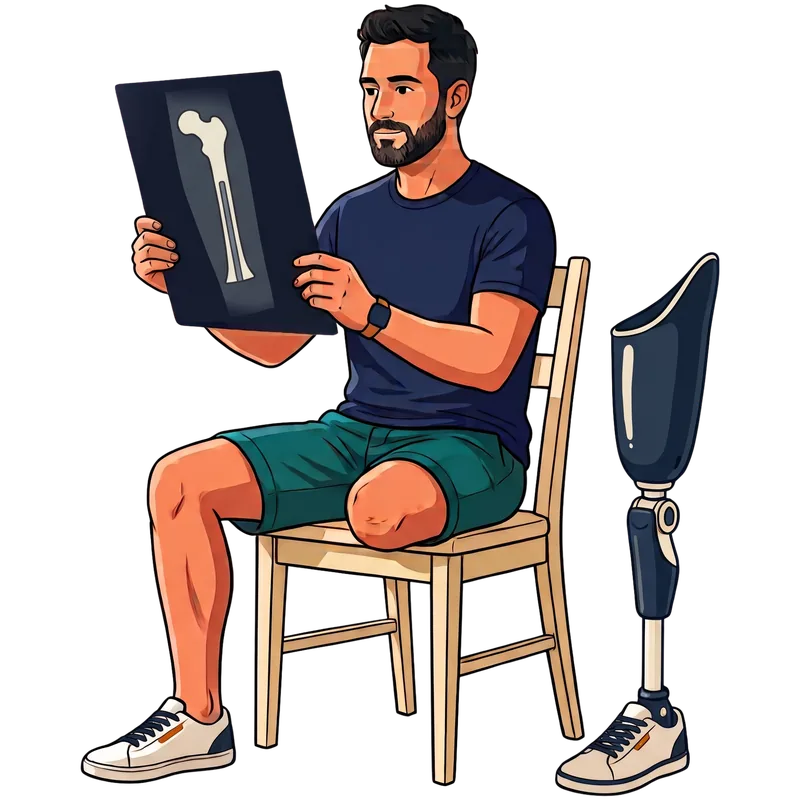
I lost my left leg at thigh level in an accident. During treatment after the accident the surgeons put an intramedullary nail into my femur and fixed the fractured greater trochanter with a screw. After almost two years osteolysis set in. That is a loss of bone tissue, in my case at the end of the femur in my residual limb. My orthopaedic surgeon decided to remove the implants, re-amputate and reshape the thigh.
I was lucky. I lost only about half a centimetre. Even so, I had to go through the whole road after amputation again from the start.
Phantom limb pain as strong as right after the accident never came back. About a year and a half later, though, a neuroma formed and the pain returned badly enough that I had to look for a solution once more. That is no coincidence. Re-amputation means cutting the nerves again. A neuroma forms at the end of every one of them, and the trouble only starts when it hurts. I write more about this in the article on neuroma and nerve procedures.
When a surgeon suggests it
A residual limb can hurt for a few typical reasons. The socket rubs the skin, a neuroma forms, or the ends of the muscles or the bone cause trouble. Sometimes a nerve is damaged during the amputation itself.
Not every one of these ends on the operating table. Doctors usually start with treatment without surgery. Quite often that is enough. An operation is considered only when the residual limb keeps causing problems and a specific cause can be pointed to. A wound infection is different. Then the second operation is done urgently.
A large study of soldiers after lower limb amputations showed that wound infection was in fact the most common reason for reoperation. Planned operations dealt with bone forming in the soft tissues, neuromas, scars and muscles that had come away from the bone. After such an operation walking ability improved and patients needed painkillers less often.
On top of that there are cases like mine, where the problem is an implant. Sometimes the residual limb has also healed into a shape that a socket simply cannot be fitted to well.
When surgery will not help
One of the older studies shows something people rarely talk about. When there was a specific cause in the residual limb, such as a chronic infection, a bone spur or a shape that made socket fitting difficult, surgery helped in the great majority of cases. When no cause was found and a neuroma was excised or the limb shortened anyway in the hope that the pain would go, roughly one person in three got relief after the first operation.
That makes sense. Phantom limb pain also arises in the nervous system above the residual limb, so shortening the bone alone will not remove it. Before anyone decides on surgery you need to know where the pain comes from, and this is why so much depends on a careful examination of the residual limb.
What to ask before the operation
Before you sign the consent form it is worth putting a few questions to the surgeon. My own story says the first one matters most.
What will be done with the nerves? A neuroma will form either way. There are now techniques meant to stop it hurting, for example TMR. Not every centre performs them, but you can always ask.
How much bone will be lost? With an above-knee amputation every centimetre counts, because a shorter residual limb gives less control over the prosthesis.
Will the muscles be attached to the bone? That decides how the residual limb will work inside the socket. In my case they were only attached during the re-amputation.
Back to the prosthesis
After re-amputation the road back to walking with a prosthesis starts almost from scratch. The wound has to heal, and the residual limb will swell and change volume for several weeks, so the old socket usually stops fitting and a new one has to be made. I described what this looks like week by week in the articles on changing residual limb volume and on swelling and compression. Compression, exercises and the first fittings are set by your treating team, not by a schedule found on the internet.
If this decision is waiting for you, ask the surgeon about the neuroma before you sign the consent form. That is the best moment to talk about how the nerves will be protected.
Pass it on
Know someone who could use this text? Send it to them.
What comes next
Next step Where to get pain treatment Pick a region and you will see pain clinics contracted by NFZ, with address, phone number and the waiting time each of them reported to the Fund.- ArticleNeuroma, radiofrequency ablation, cryoablation and nerve surgery. What to do when the pain comes back years later
- ArticleChanging residual limb volume. Why a prosthesis holds better in the morning than in the evening
- ArticleSwelling and residual limb compression. Bandage, shrinker, liner and when to start
Got a question? Write to us through the contact form. We answer every message.

Sources
- „Pacjent po amputacji kończyny. Postępowanie i powikłania”, an article on the Medycyna Praktyczna patient service: mp.pl
- „Ból po amputacji”, material from the Polish Association for the Study of Pain: ptbb.pl
- „Residual Limb Complications and Management Strategies”, Current Physical Medicine and Rehabilitation Reports, 2014: scholar.usuhs.edu
- „Reoperation after combat-related major lower extremity amputations”, Journal of Orthopaedic Trauma: scholar.usuhs.edu
- „The value of revision surgery after initial amputation of an upper or lower limb”, Prosthetics and Orthotics International, 1987: oandplibrary.org
- „Salami-Tactics: when is it time for a major cut after multiple minor amputations?”, Archives of Orthopaedic and Trauma Surgery, 2021: ncbi.nlm.nih.gov